|
|
|
|
|
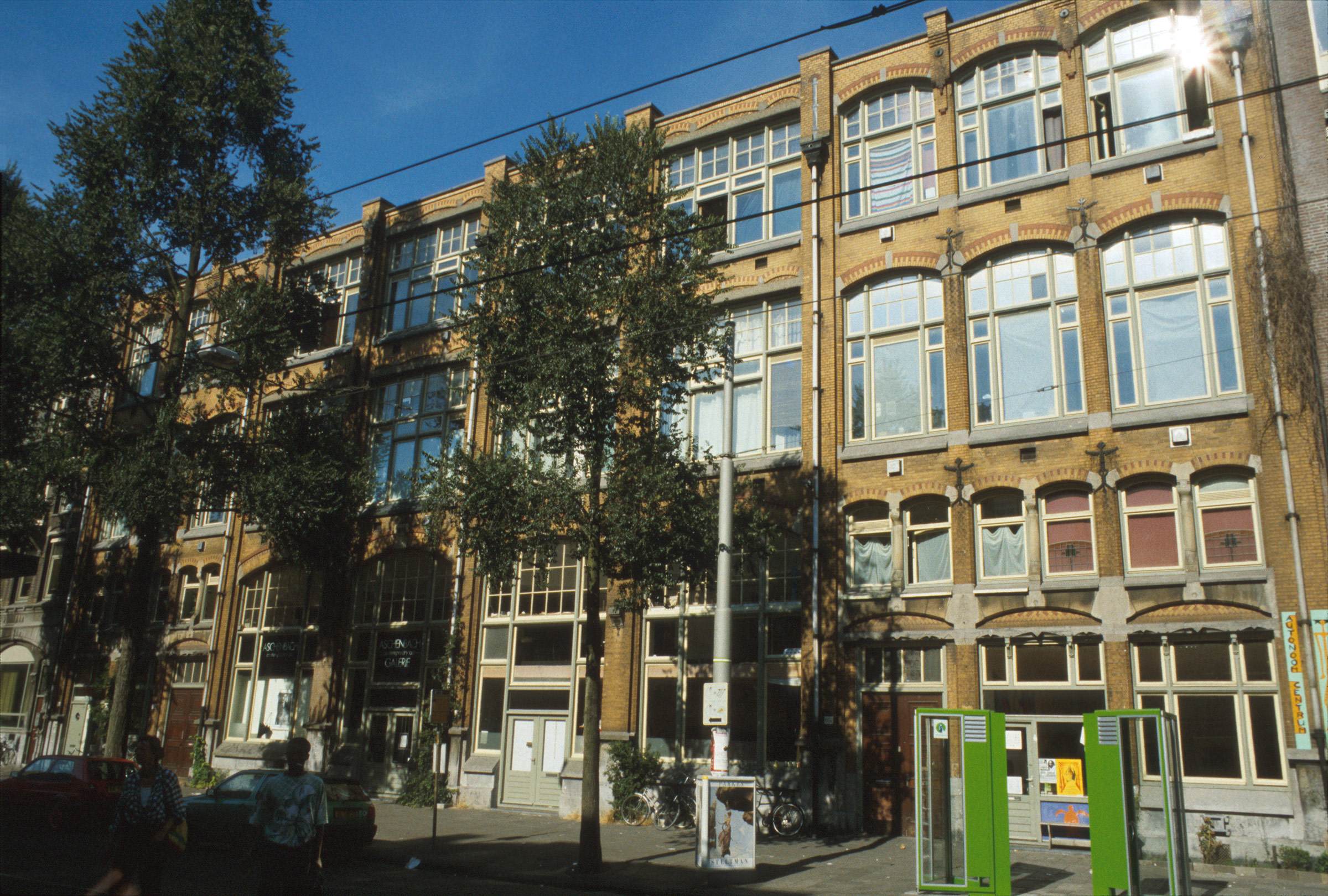
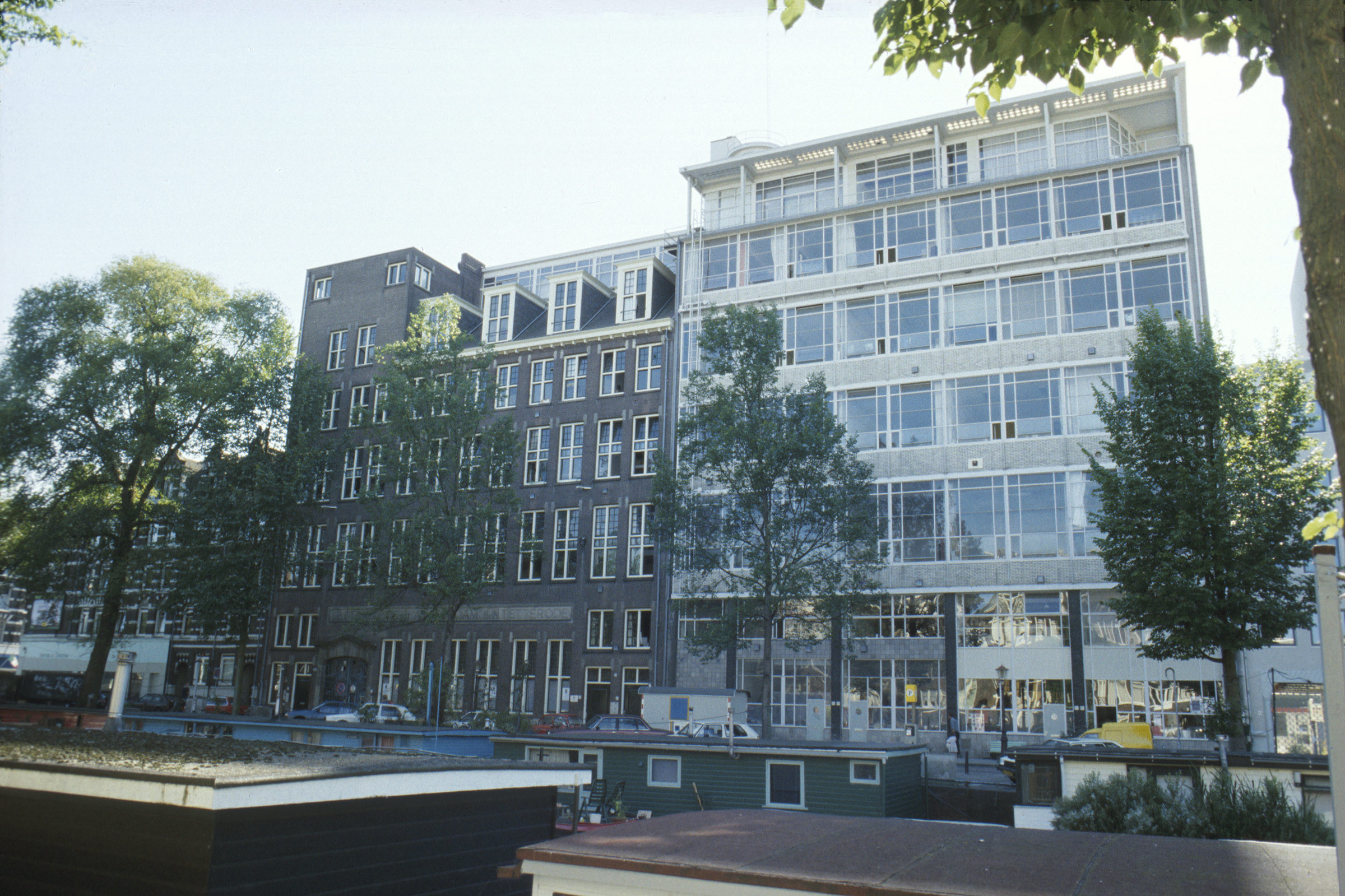
TETTERODE - BILDERDIJKSTRAAT FACADE (pic 08-1995 / to NW) |
©
DAVID CARR-SMITH 2005 : all images & text are copyrighted - please accredit
text quotes - image reproduction must be negotiated via [email protected]
Key
F11 for full-screen on/off.
Click
on images to enlarge.
CONTENTS
4 SITES
TETTERODE
DE LOODS
EDELWEIS
APPENDICES
NOTES
SUB-SITES
BOOK: DAVID CARR-SMITH - IMPROVISED ARCHITECTURE IN AMSTERDAM INDUSTRIAL SQUATS & COLLECTIVES
"TETTERODE" SQUAT 1981-/COLLECTIVE 1986 to-- -p1(of 18)
TETTERODE - p1: INTRODUCTION
> TETTERODE - p2: PUBLIC-USE &
WORK-SPACES >
>
TETTERODE - p3: RESIDENTIAL DOMAINS >
> TETTERODE - p4: DACOSTAKADE BUILDINGS: MERKELBACH & HARTCAMP >
> TETTERODE - p5: DACOSTAKADE: MERKELBACH APTS - mb//mb1/mb2 >
> TETTERODE - p6: DACOSTAKADE: MERKELBACH APTS - mb3 >
> TETTERODE - p7: DACOSTAKADE: MERKELBACH APTS - mb4 >
> TETTERODE - p8: DACOSTAKADE: MERKELBACH APTS - mb5/mb6 >
> TETTERODE - p9: DACOSTAKADE: HARTCAMP APTS - hc//hc1/hc2 >
> TETTERODE - p10: DACOSTAKADE: HARTCAMP APTS - hc3 >
> TETTERODE - p11: DACOSTAKADE: HARTCAMP APTS - hc4(1) >
> TETTERODE - p12: DACOSTAKADE: HARTCAMP APTS - hc4(2) >
> TETTERODE - p13: DACOSTAKADE: HARTCAMP APTS - hc5/hc6 >
> TETTERODE - p14: BILDERDIJKSTRAAT BUILDINGS >
> TETTERODE - p15: BILDERDIJKSTRAAT APTS - bd//bd1 >
> TETTERODE - p16: BILDERDIJKSTRAAT APTS - bd2 >
|
|
|
|
|
TETTERODE - BILDERDIJKSTRAAT FACADE (pic 08-1995 / to NW) |
.
TETTERODE INTRODUCTION
THE
FACTORY, THE SQUAT, THE COLLECTIVE
THE
SITE AND PATTERN OF OCCUPATION
.
INTRODUCTION
I first photographed Tetterode in 1990. In 93/94 I made the bulk of the 1990s living-space recordings. In 2006 I resumed recording Tetterode's exteriors and circulation-spaces. In 2008, after an interval of 14 years, I made a new set of recordings of many living-spaces (including some not previously visited) in all but one of Tetterode's fifteen enclaves.
Significant design-developments here are almost always driven by home-elaborating individuals and design-development is the principal theme of this account - thus with regard to living-spaces (and sometimes their enclaves) the 2008 recordings are displayed separately but 'in parallel' with those from the 1990s to facilitate comparisons. With regard to the building exteriors and circulation spaces the main consideration is establishing a sense of the geography of the site, thus though there were late-90s Collective-initiated 'improvements' in these areas these are superficial and such images are inserted in location-sequence irrespective of date.
In the mid 1990s Tetterode contained and supported approx 55 rented work-spaces and approx 73 living-spaces - in 2008 there are approx 67 due to merging of living-spaces. This huge collaborative enterprise (the Tetterode Collective) is organised by an elected committee which administers its interface with external authorities, and ideas, initiatives, practical tasks which issue from any of its social units (individuals, enclaves, external-renters) which may affect its communal aspects. Living-space initiatives, apart from those that impinge on the community (such as expanding an apt into shared circulation space), are private. Both the scale of essential administration and degree of interference in personal choice seems (surprisingly) minimal.
This TETTERODE section is organised in three parts:
p
1: THE SITE:
Introduction - Tetterode's history as a factory and its redevelopment as a
working and domestic squat/collective. The organisation of its site and
buildings, entrances and ground-level internal routes (the account of
internal circulation is expanded in part-3 Residential Domains).
p
2: WORK PLACES:
Enterprises (mainly externally rented) and their locations: street-shops,
businesses, workshops.
p
3 - 18: RESIDENTIAL DOMAINS:
Residential locations and individual living-spaces. The three main
residential buildings - each containing a stack of individually organised
domestic 'enclave' floors - are shown in the following order:
p 4: DA COSTAKADE:
two joined buildings: 'Merkelbach' and 'Hartcamp':
p 5 - 8: Merkelbach
p 9 - 13: Hartcamp
p 14: BILDERDIJKSTRAAT:
two adjacent buildings: 'Old' and 'North':
p 15 - 17: Bilderdijk
Old building
p 18: Bilderdijk
North building
.
THE FACTORY, THE SQUAT,
THE COLLECTIVE
Nicholas Tetterode opened his ‘Lettergieterij’
(making cast-lead printing type) on the Bloemgracht in 1856.
In 1901 the Tetterode factory
was moved to the south end of Bilderdijkstraat near its junction with the
Kinkerstraat. The architect J.W.F.Hartkamp designed the new Bilderdijkstraat building (famous
for its enlightened ‘humanitarian’ provisions for the workers) and added a
third floor in 1906, initiating the factory that the firm occupied until 1981
when it began its radical transformation by ‘squatters’ into housing.
In 1912 the factory site was extended eastward and
Tetterode acquired a second street-front on Dacostakade with
a second (and less inspired) J.W.F.Hartkamp
block. In 1921 there was an internal
expansion, and a Hartcamp re-vamp of the Bilderdijk building that acquired its
de Lugt designed marble-floored and panelled entrance-hall. The final site
enlargement began in 1941 with a single level repair shop extension northwards
along Dacostakade. In 1949 this grew upwards into Merkelbach Karsten and
Elling’s graceful concrete and glass block. Internally the junction of the
1912 and the 1941/49 buildings is a common stair and lift - externally the
older building is at last afforded a role: its dull solidness enhances by
contrast the light transparency and delicate poise of Merkelbach’s ‘Functionalist’
facade, which binds the other to it by releasing rhythms implied in its
repetitive fenestration, and finally (in 1963) by reaching out along its top as
a glass pavilioned penthouse.
In 1981 the Tetterode company
merged with another and moved its factory elsewhere. The empty Tetterode was
sold to a building contractor whose ‘re-development’ ambitions were
intentionally frustrated by squatters.
Tetterode was ‘cracked’ on
the 17th of October 1981 after two weeks observing the routines of the security
guards. These guards and the carpenters who were dismantling valuable wood
panelling and fittings in the admin and public areas of the buildings to take
to the company’s new premises, were made to leave by the squatters. Thus the
decor of the company’s ‘impressive’ Bilderdijkstraat Entry-Hall is still
almost complete, though the famous Library (now the DijkTheatre)
had
already been completely stripped.
During the early stage squatters
and security guards changed places several times, until the High Court ruled
in favour of the squatters’ right to be there. Of
the many people involved in this
initial phase of squatting very few
intended to permanently live there. A local neighbourhood group of 30 or so
squatted to preserve the buildings and camped in them, another 7 or 8 squatted
as a political action. Of the many involved only about 10 participated in the
eventual clearing and building of services and living-spaces.
In spring ‘82 a second phase of
squatting began, a ‘domestic’ occupation of the Dacostakade building which
later spread to the Bilderdijkstraat side. The latter building’s inner
courtyard-front had been sealed for defense by the first squatters and its huge
potential as living-space was ‘rediscovered’ only when entered from its
3rd-level access bridge.
With the re-development plans of
its new owner legally blocked the site was re-sold in 1982 to a Pension Fund
that was apparently happy to rent it to the squatters but is said to have been
“authoritarian and patronising” and the relationship failed (gossip
estimates that their involvement with Tetterode eventually lost them some
12,000,000 Guilders). It was sold yet again to less scrupulous speculators
and eventually, after more legal wrangling bought by the City Council. The
City had no development plans for the Tetterode neighbourhood and
had never objected to its occupation. As its interface with Tetterode it appointed a
non-profit philanthropic housing-corporation with an interest in low-income
housing: the ‘Voningbouwvereniging het Oosten’ (with which the squatters had
already held positive discussions) with the aim of negotiating the terms of a
mutually acceptable contract.
In 1982 the Tetterode squatters
had become a legal ‘Collective’ properly constituted with director,
treasurer and secretary: the “Vereniging Ruimschoots” (loose translation:
‘Collective Lots and Lots’) - as this collective entity they “paid
electricity bills and represented themselves”. In 1986 a contract between
Het Oosten and the ‘Collective Lots and Lots’ was successfully
negotiated and signed - to meet its requirements the Collective’s structure
had been revised to include in its terms the whole building and
each tenant, whether resident or renters of work-space - from then on the occupation of
Tetterode is a normal residency. The parties decided on a ‘Casco rent model’
(‘casco’ (a ship’s ‘hull’) here refers to the basic carcass of the
building: structural walls, roof, foundations, floors, electricity supply from
street to meter), the Collective would rent Tetterode’s ‘casco’ from Het
Oosten (for 264,000 Guilders per year reviewed every 15 years) and Het Oosten (with City finance of 2·4 million Guilders) would renovate and
maintain it. The residents - if they did not contravene safety regs - retained their former
planning independence. The Casco scheme was considered “ideal for young
low-income resourceful self-help people” [1].
The renovation was not only
expensive for the City but also for the tenants of the Collective - its new
status required conformity to various regulations, few of which concerned the ‘casco’:
the ageing factory cabling (bandaged copper in steel tubes!) must be replaced and
inspected; gas be fitted by contractors; fire regs to be satisfied with changes
to enclosures and exits: removal of the courtyard-covering roof for escape to
the open air, separation of workshops and living-spaces (‘studio-apartments’ a
wrangled exception!).
Three years before the contract
was due the squatters had begun to pay into their Collective the higher rent
anticipated from Het Oosten, using this accumulation to initiate certain
renovations themselves - which risky investment (it is claimed) so persuaded Het
Oosten of their seriousness that it positively induced the latter to sign.
Tetterode’s new legalised
security provoked an influx of aspiring residents [2], and higher rents forced many
who only worked there to move their homes inside. Building was energetic and
cheap - the outer walls of living-spaces and all other shared aspects of
Tetterode are financed from Collective rents and the new activity was boosted
by an unforeseen Het Oosten grant [3] for internal renovations - everywhere
sub-dividing of floors was planned and finalised with the ubiquitous cement-block
walls. During four years or so after ‘86 (especially on the Dacostakade side -
previously almost all studios) the physical and social environment rapidly
changed and Tetterode acquired its present form.
The huge domestic structure of
about 80 residents in 65 living-spaces and studios is piled on top of
a busy work environment. Throughout Tetterode’s ground floors and
basement, and in the Merkelbach L-1 "entresol" are work-places: around 55 spaces are
rented to outside businesses (there is a waiting list!) - thus the lower
parts of Tetterode are ‘connected to the city’ by way of a population of
commuters! Foot-Notes
: Quote:
in
process
...
Only the Collective can give notice or approve aspiring residents - though in
practice it’s usually enough to be invited by a floor-enclave.
Interest from a delayed use of the ‘Casco’ fund (see above: legalisation).
Merkelbach’s
basement was converted in 1992.
“De Trut” is in the semi-basement of Bilderdijk, under the Lettermagazijn.
When
renovated the kindergarten acquired a new playground, designed and made by
Rein van der Vliet (1995).
Sources
:
Company and Building History: “Tetterode
Nederland Amsterdam” archive: courtesy of Mr.
Wim W Timmer (Jan ‘95).
General
info: Book; “Tetterode Complex”, Peter Sap, pub: De Balie - S.E.V - WV.
Het Oosten.
‘Casco’ and rental info: Tetterode: Vereniging admin (Rein van der Vliet, ‘95).
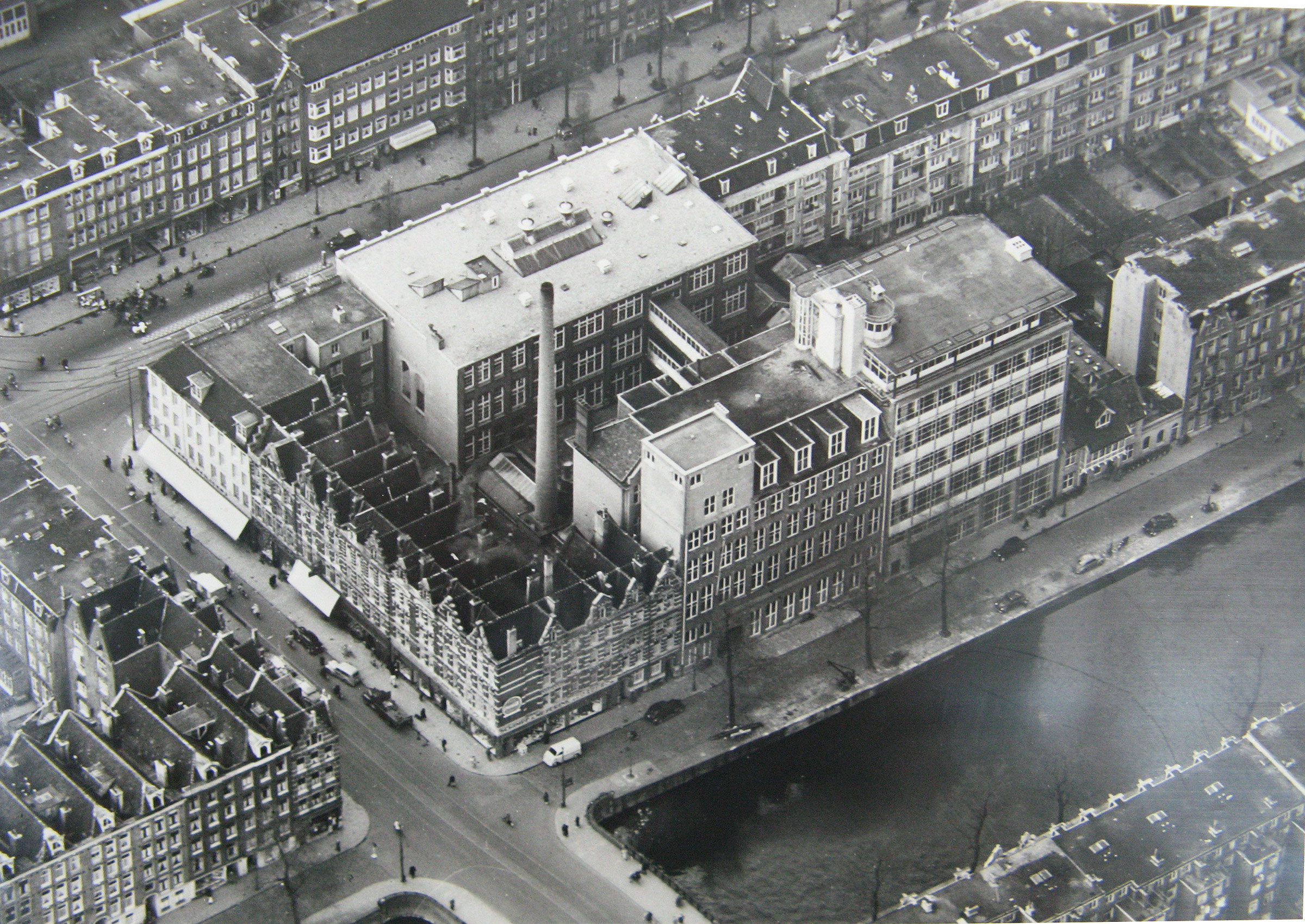
TETTERODE: WHOLE SITE
(air-photo:
date between 1950 and 1963 / to WWN)
[Photo: “Tetterode Nederland Amsterdam” archive: courtesy of Mr. Wim W
Timmer]
In
these two photos the
whole site is complete except for Merkelbach's 1963 penthouse extension across the Hartcamp
building's roof. The
Tetterode factory straddles the width between two streets near the south end of a city-block
bounded by Bilderdijkstraat (background), Dacostakade (foreground canal),
and Kinkerstraat (across the left corner). Its chimney marks its south
boundary. Its Dacostacade front consists
of the two adjacent buildings beyond the sharp-gabled corner block -
the first is the Hartcamp's 1921 building (minus its 1963 penthouse), the
second Merkelbach's 1949 block.
TETTERODE: WHOLE SITE
(air-photo:
date between 1950 and 1963 /
to NNW)
[Photo: “Tetterode Nederland Amsterdam” archive: courtesy of Mr. Wim W
Timmer]
In
the foreground the Bilderdijkstraat (left) meets the Kinkerstraat.
Tetterode begins beyond the pale corner building and its sharp-gabled
neighbours. Tetterode's first factory building on this site is the pale
rectangular 1901 Bilderdijkstraat block. This is separated by a central
courtyard (still roofed in this picture), but joined by two bridges to the
later 'Hartcamp' and 'Merkelbach' Dacostakade block..
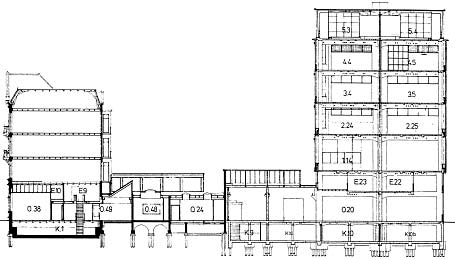
TETTERODE:
SECTION - FROM BILDERDIJK NORTH-BUILDING (bdN) ACROSS N-END WORKSHOPS TO
DA COSTAKADE MERKELBACH (mb)
(Architect-Drawing c1984 / section WWS to EEN)
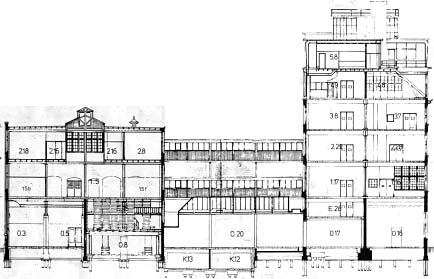
TETTERODE:
SECTION - FROM BILDERDIJK OLD-BUILDING (bd) ACROSS COURTYARD TO DACOSTAKADE
HARTCAMP (hc)
(Architect-Drawing 4-1984 / section WWS to EEN)
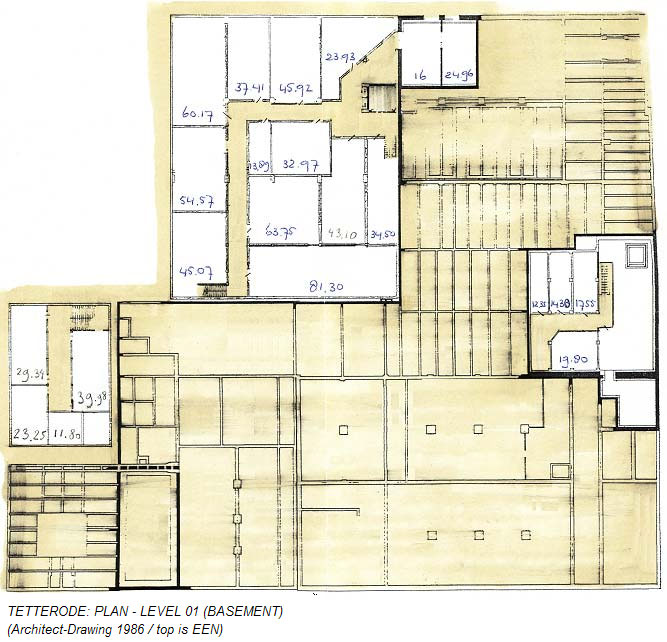
TETTERODE:
PLAN - LEVEL 01 (BASEMENT)
(Architect-Drawing
1986 / top is EEN)
TETTERODE:
PLAN - LEVEL 0 (GROUND)
(Architect-Drawing 1986 / top is EEN)
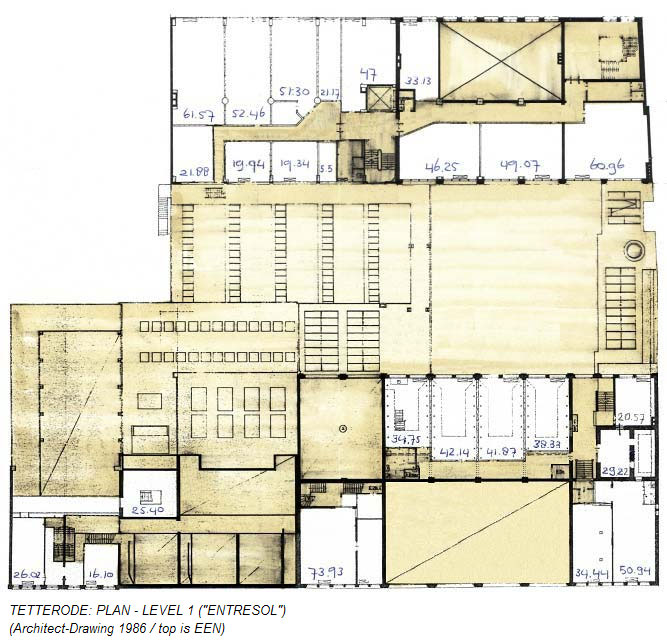
TETTERODE:
PLAN - LEVEL 1 ("ENTRESOL")
(Architect-Drawing
1986 / top is EEN)
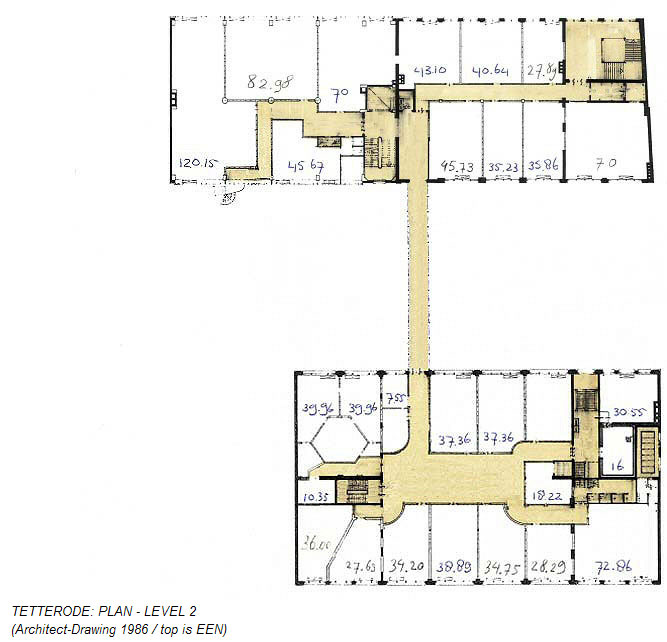
TETTERODE:
PLAN - LEVEL 2
(Architect-Drawing
1986 / top is EEN)
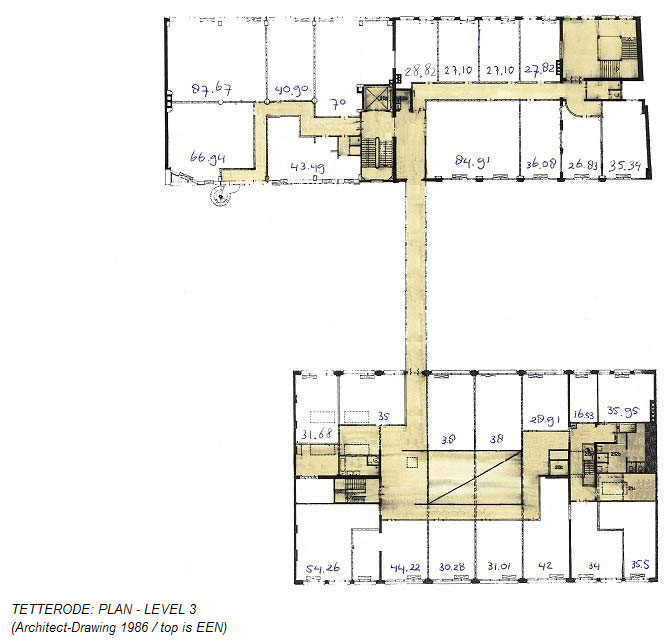
TETTERODE:
PLAN - LEVEL 3
(Architect-Drawing
1986 / top is EEN)
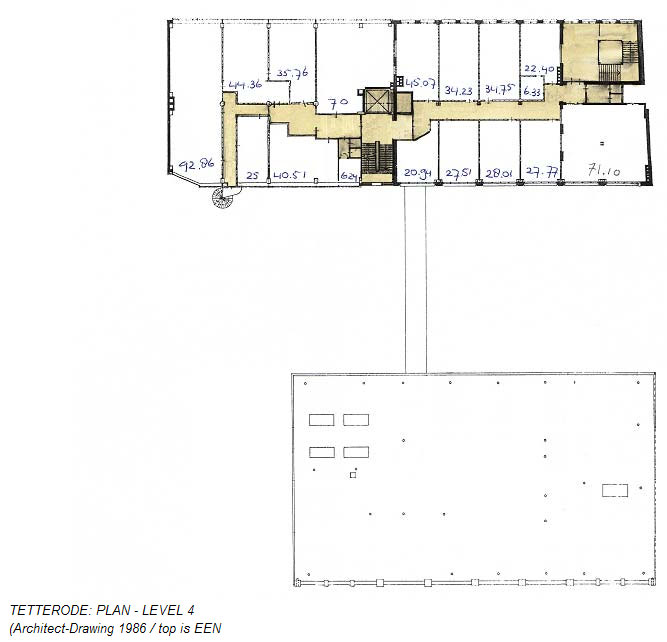
TETTERODE:
PLAN - LEVEL 4
(Architect-Drawing
1986 / top is EEN)
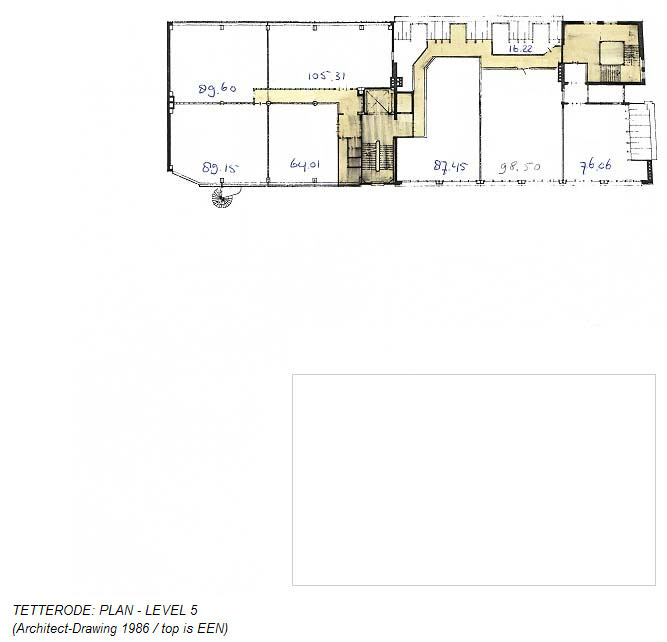
TETTERODE:
PLAN - LEVEL 5
(Architect-Drawing
1986 / top is EEN)
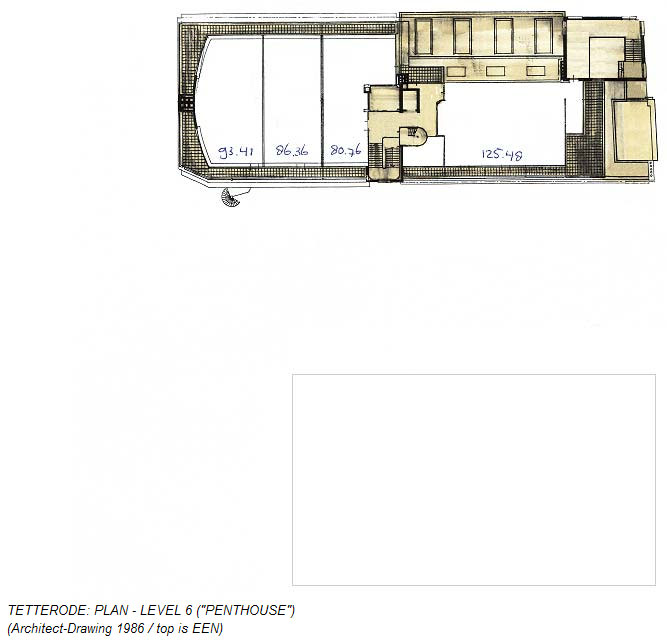
TETTERODE:
PLAN - LEVEL 6 ("PENTHOUSE")
(Architect-Drawing
1986 / top is EEN)
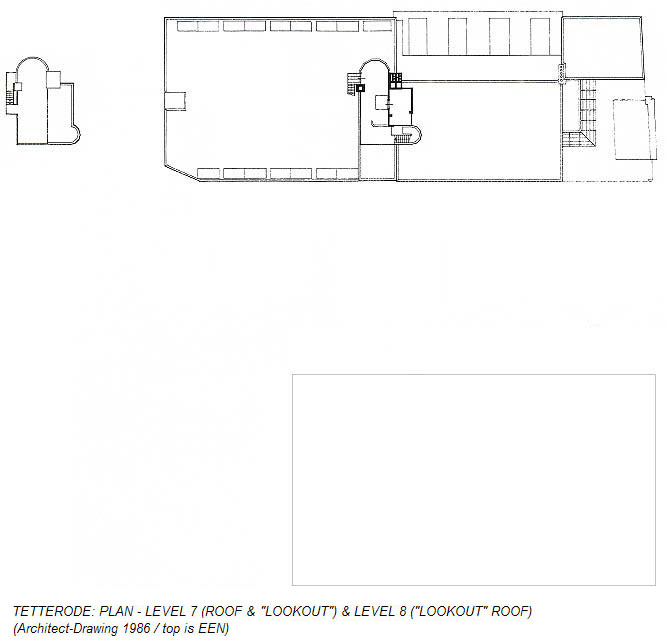
TETTERODE:
PLAN - LEVEL 7 (ROOF & "LOOKOUT") & LEVEL 8 ("LOOKOUT"
ROOF)
(Architect-Drawing
1986 / top is EEN) .
THE
SITE AND PATTERN OF OCCUPATION
Tetterode spans a city-block - a big rectangular
castle with a 20m square central courtyard, its ends closed by workshops and its sides by two huge
apartment buildings, both fronting streets. The
east faces the charmed tree-lined calm of the house-boat fringed
Dacostakade, the west faces the busy shopper-thronged tram-clanking
Bilderdijkstraat. Enter Tetterode at either side and exit on the other into a
different city!
The buildings’ conventional layers of big
(typically around 400m2) unobstructed floors (already cleared of
machines, but often cluttered with debris) presented few obstacles to apt
building. Apart from the need in
such a large scattered site for a sense of social identity and security, the
formation of enclaves was an almost inevitable consequence of the buildings’
structural division into doored workshop-floors, accessed from main stairs -
each easily sub-divided into a group of apts (sharing a shower/wc and kitchen)
opening onto an internal passage [1],
or in the less regular Bilderdijk building, a communal-hall space.
One of the characteristics of a visit to Tetterode is
that - in spite of its atmosphere of active social community, the sense of
manifold yet contained activity one gets in an isolated village - the whole
place is extremely fragmented and neither entry or internal exploration is
possible without keys. The
devolution into enclaves intensified after the ‘86 legalisation when, during
work by outside building contractors, street doors were often open and there
were many thefts by interlopers - thus some of the cross-passages and ways
around and through, that had bound together the huge set of buildings and maintained the sense, in spite of its enclaves, of a single warren-like
community - were blocked or locked. Even
the site’s single (if convoluted) main circulation system which (except for
two apts opening onto local entry-stairs) reaches all the enclaves [2] and the
scatter of single apts and workshops, may be obstructed: recently both the
large residential blocks had locked their exits into the central court,
segmenting one of the two main routes that wind across the site from one
street-front to the other, confining keyless visitors to a single block -
increasing to the scale of whole buildings the sense of social divisions.
If it’s
hard to get around inside it’s also hard to choose a way in - Tetterode
castle's first defense is to confuse entry intentions. On its two street fronts Tetterode
has 18 doors. 8 doors access ‘public cul-de-sacs’: single spaces entered directly from the street
with no public access to the Collective's 'castle'; most of these,
such as Bilderdijk's shops visibly
serve only the street, however two (Bilderdijk’s night-club and Dacostakade’s
Dijktheatre) confusingly resemble residential doors
and open into passageways. 10 doors access the Collective's semi-public and residential spaces: 2 of these (one for vehicles) lead straight and visibly
into the central courtyard; 4 are the street-doors of Merkelbach L0 workshops; 5
access semi-public and domestic residential domains - 2 of these into mazes of routes and
junctions [3] and 3 to a local enclave and enclave-accessing stairs.
The Dacostakade side lacks the public open face of Bilderdijkstraat.
At its north end are the private school and rented Merkelbach workshops. Near the block’s centre,
next to the Dijktheatre door, is the main residential entrance (framed in
labelled bells) into a tunnel-like passage to the main stair and a ramifying
confusion of routes throughout the whole site. At the extreme south end
through a little-used door, one may access a dirty foyer under a towering mesh of
rusty lift-shaft; slog up the labour of its circling 'north-stair' - each landing
presenting the locked ‘rear-end’ of a floor-enclave - and, if the climber persists enough to reach the apparently blocked final flight
and penetrate a
seemingly private maze-like route through fragments of an occupied apt [4],
emerge onto one of Tetterode’s strangest
locations: the “Sky-Lawn” [5], a little ‘suburban’ garden cultivated on the
building’s terminating terrace 25 meters above the inner court. Adjoining
this 'north-stair' door is
Tetterode’s vehicle entrance, (often used by commuters who rent work-spaces
here); fronted by big
'castle-like' gates this is the Collective's most obvious ingress - a short straight tunnel
under the bulk of
the 1912 building and one is out into the bright courtyard.
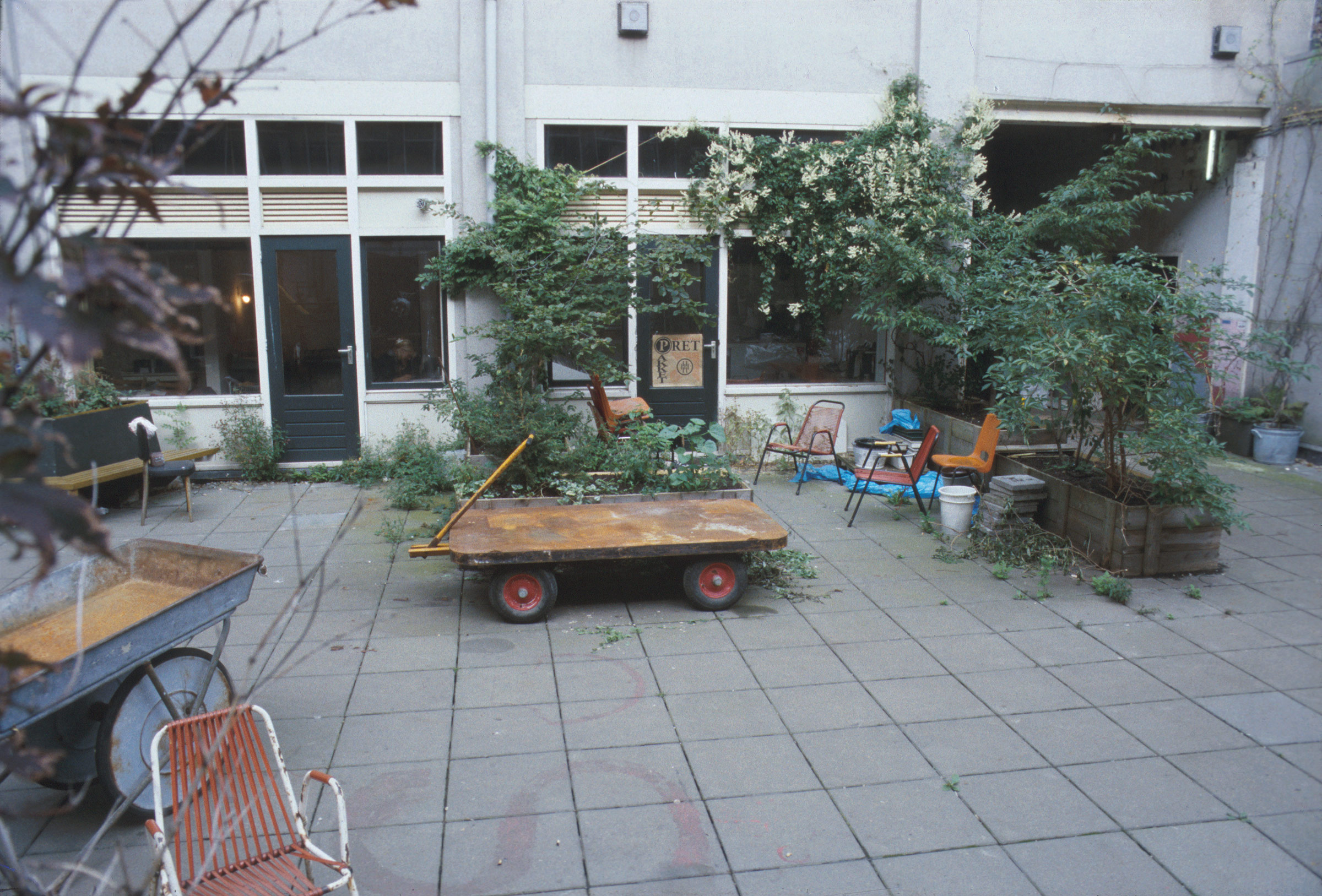
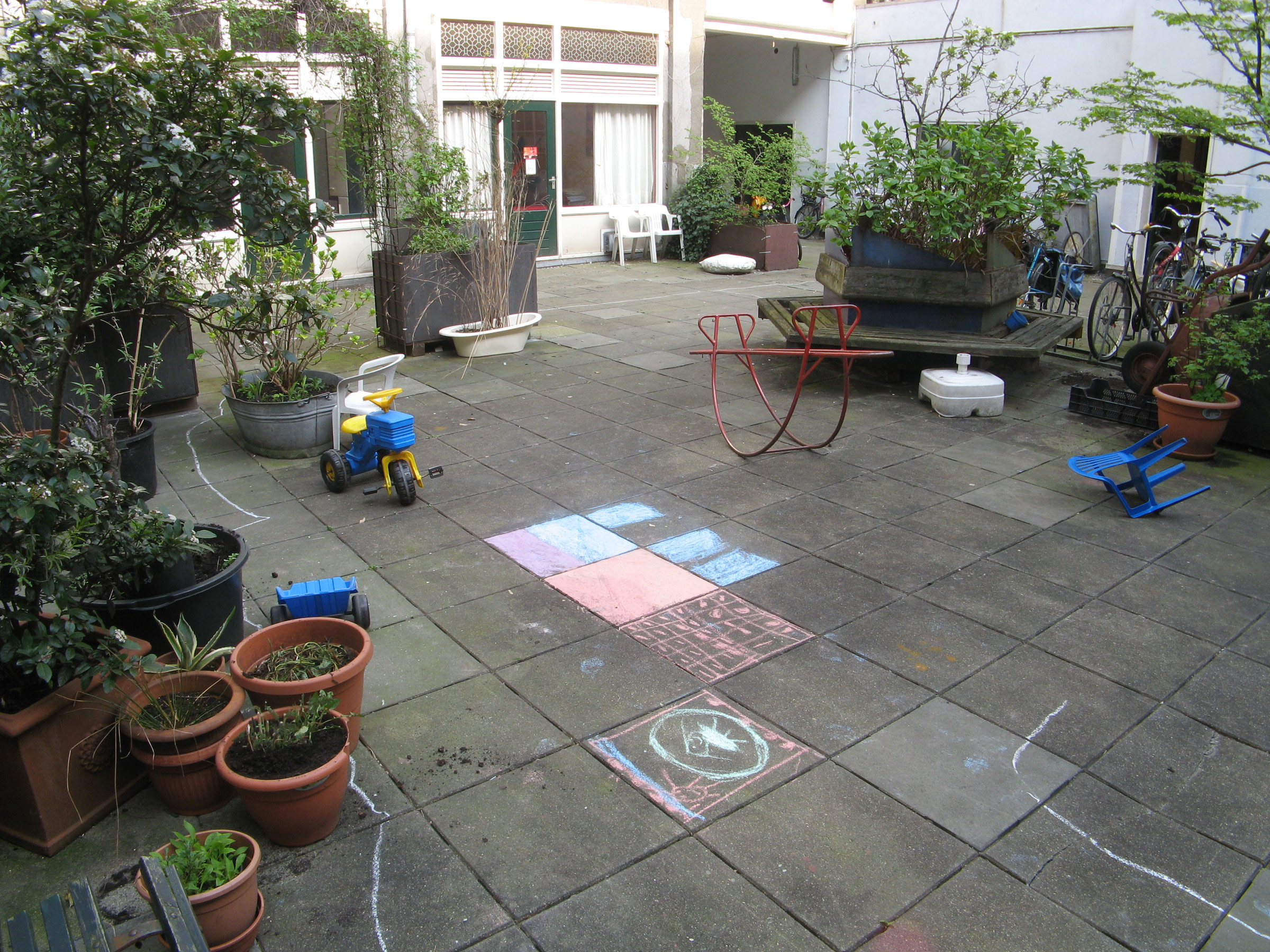
In
this inclosed court the delicate trees and small garden features,
children’s’ playground structures, seats, bikes, bakfiets, and signs of
work in progress, would all be ‘out of place’ in a well-regulated factory
let alone a large hotel. More warm and home-like than a ‘housing-scheme’: the social ambience is somehow too
relaxed, even in the deserted courtyard - signalled in a myriad unobtrusive
details: a possession unattended, a domestic chair, a cup with tea, a silvered
window, a glimpse of structures built inside the rooms. The overlooking windows seem friendly
and active; one is led by the details of collectively shared domesticity to
remember that behind none of them are sterile suburban strained attempts to
out-do neighbours and upbringing, to mimic perfection or wealth; or the death-empty
average of hotel rooms; but the rich multiplicity of individuality and choice
expressed.
At
each end the courtyard presents a dramatic view-event framed between the big
slabs of living-spaces. Above the
south side workshops a remarkable row of super-sharp 19th century
house gables like the lower jaw of a trap, threatens the square of sky held down
between the flanking blocks - this stage-like setting is bisected by a thin tall
chimney. Opposite, on the north side, the space is closed as if by a huge slatted wall: the workshops
extend upwards as two flat-sided windowed bridges perched on legs like stacked
coaches, joining Merkelbach and Bilderdijk.
Foot-Notes
: Most
emphatic in the Dacostakade buildings whose regular stacks of rectangular
doored-floors branch from the central stair/lift like locked cul-de-sacs. All
enclaves except the narrow, domestic-style building that extends the
Bilderdijkstraat
frontage northwards
from the original 1901 factory block: the 'Bilderdijk North-Buildings'. The
least specialised of Tetterode's 2 main routes gathers almost all the others
- from the N-end workshops, the whole east side, the
central Court, and thus (rather indirectly) the west side -
like tributaries into the
becalmed lake of the panelled Company Reception Hall, from which, after
circling its central column, they pour into the Bilderdijkstraat through the
erstwhile Tetterode Company's admin
entrance [see below].
The
apt in question has ‘burst its bounds’: grown across a Collective
corridor which now resembles ‘private-space’, seemingly cut-off the 'Sky-Lawn' from shared use,
and via a platform even invaded the (redundant)
lift-shaft! “Sky-Lawn”
is my name for this little garden with no horizon but its handrail and the
sky.
TETTERODE
ENTRANCES: PUBLIC AND RESIDENTIAL -
PLAN - LEVEL 0 1:
'Front-Doors' into
the Collective: used by residents and outsiders who rent work spaces. 2:
Entries into public-use 'cul-de-sacs': shops, disco, theatre, etc..
.
TETTERODE'S EXTERIOR FACADES
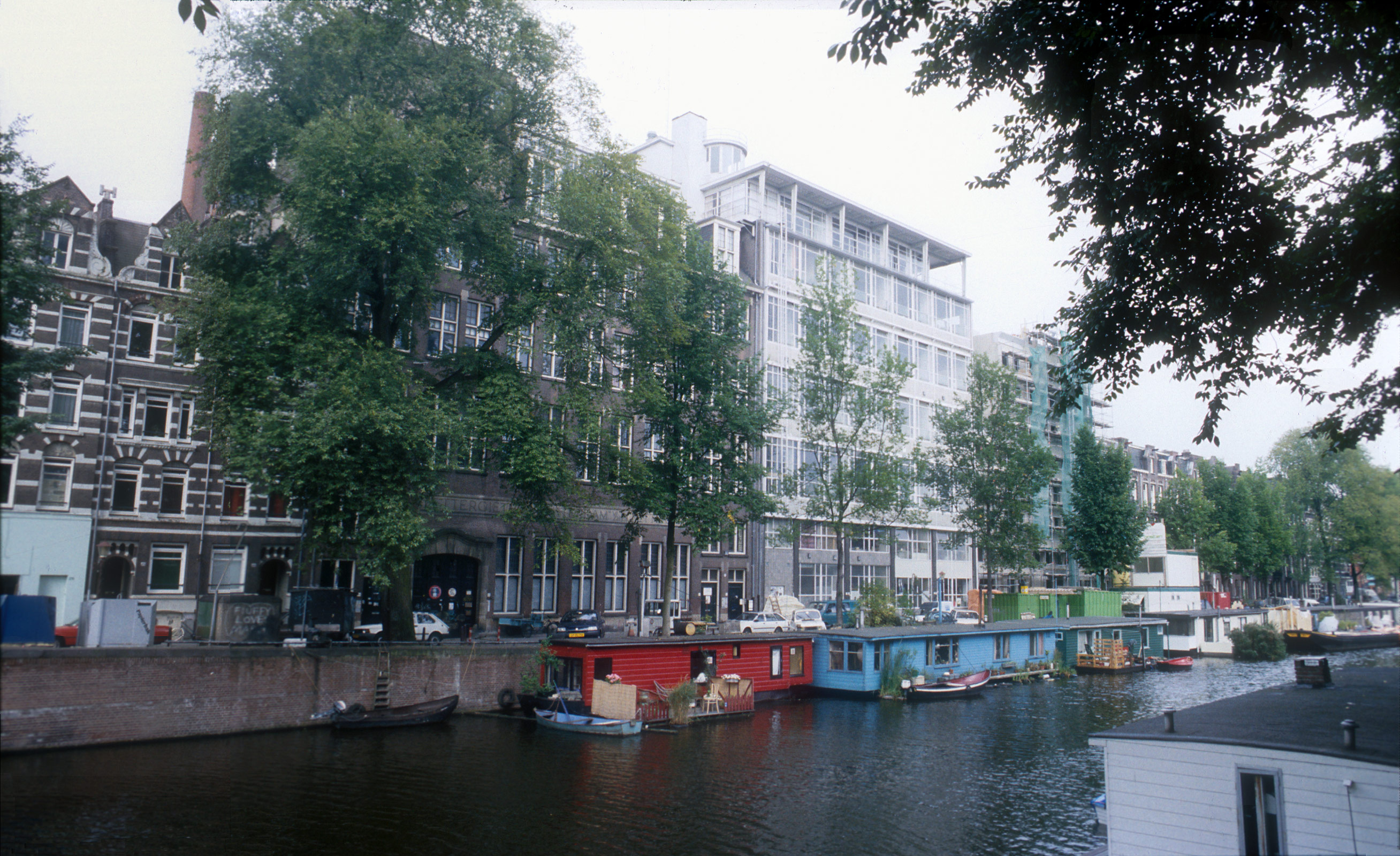
DA COSTAKADE EAST-FACE OF TETTERODE (paste-up
2-pics 09-1994 /
to WWN) The
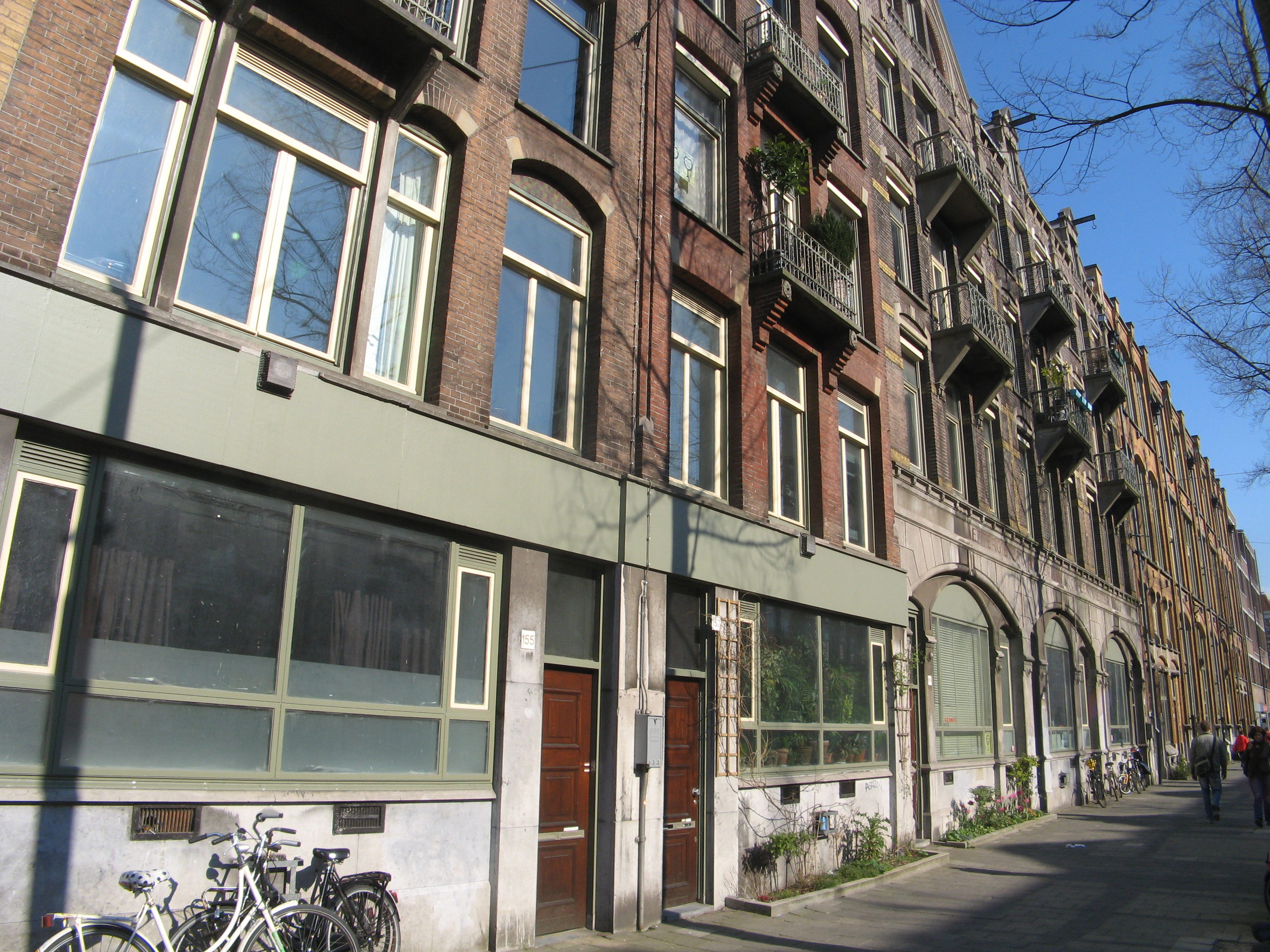
east side of Tetterode fronts the tree-fringed Dacostakade, its canal edged with
house-boats that sometimes spread small
gardens on the pavement - a peaceful idyll.
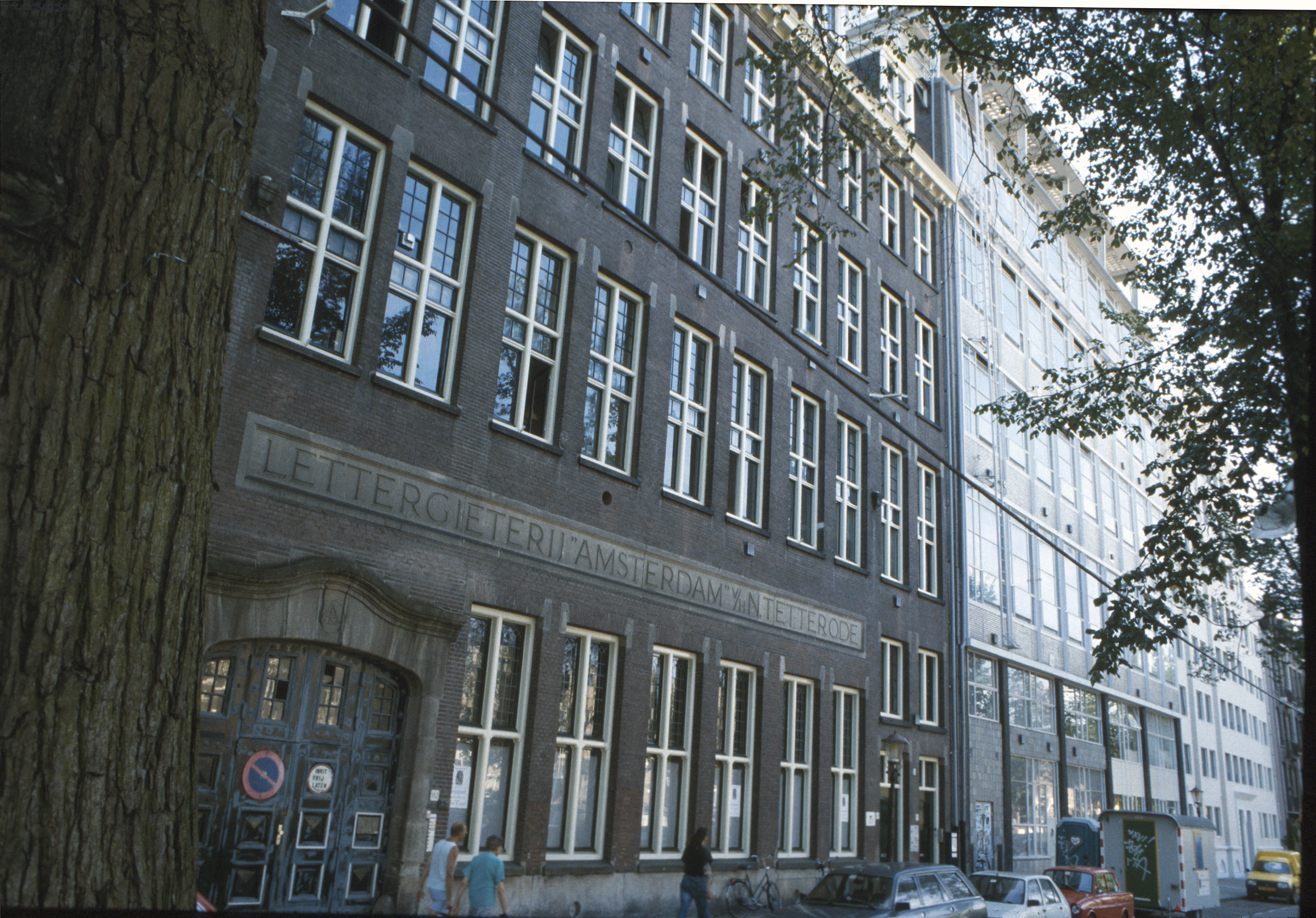
DA COSTAKADE EAST-FACE OF TETTERODE (pic
08-1995 /
to WWS) Tetterode’s first
Dacostakade building was the 1921 Hartcamp; in 1949 the factory expanded again with the elegant concrete
and glass 7-level Merkelbach block; finally in 1963 Merkelbach's
steel and glass 'penthouse' was extended across the top of Hartcamp.
DA COSTAKADE EAST-
FACE OF TETTERODE
(pic 08-1995 / to NW) At
the south end of the 1921 Hartcamp building Tetterode's big vehicle entrance opens directly into the central courtyard's SE
corner. The six large windows were the erstwhile Company Library, now the Dijk
Theatre, whose entry-door abuts their north end. The final door, at
Hartcamp's north
end, serves the whole
Dacostakade block's main stair/lift, and a
nexus of routes that ramify through the
whole Tetterode site. North of Hartcamp the Merkelbach building fronts the street
with its four rented workshops.
BILDERDIJKSTRAAT WEST-FACE OF
TETTERODE
(pic 09-1994 / to N)
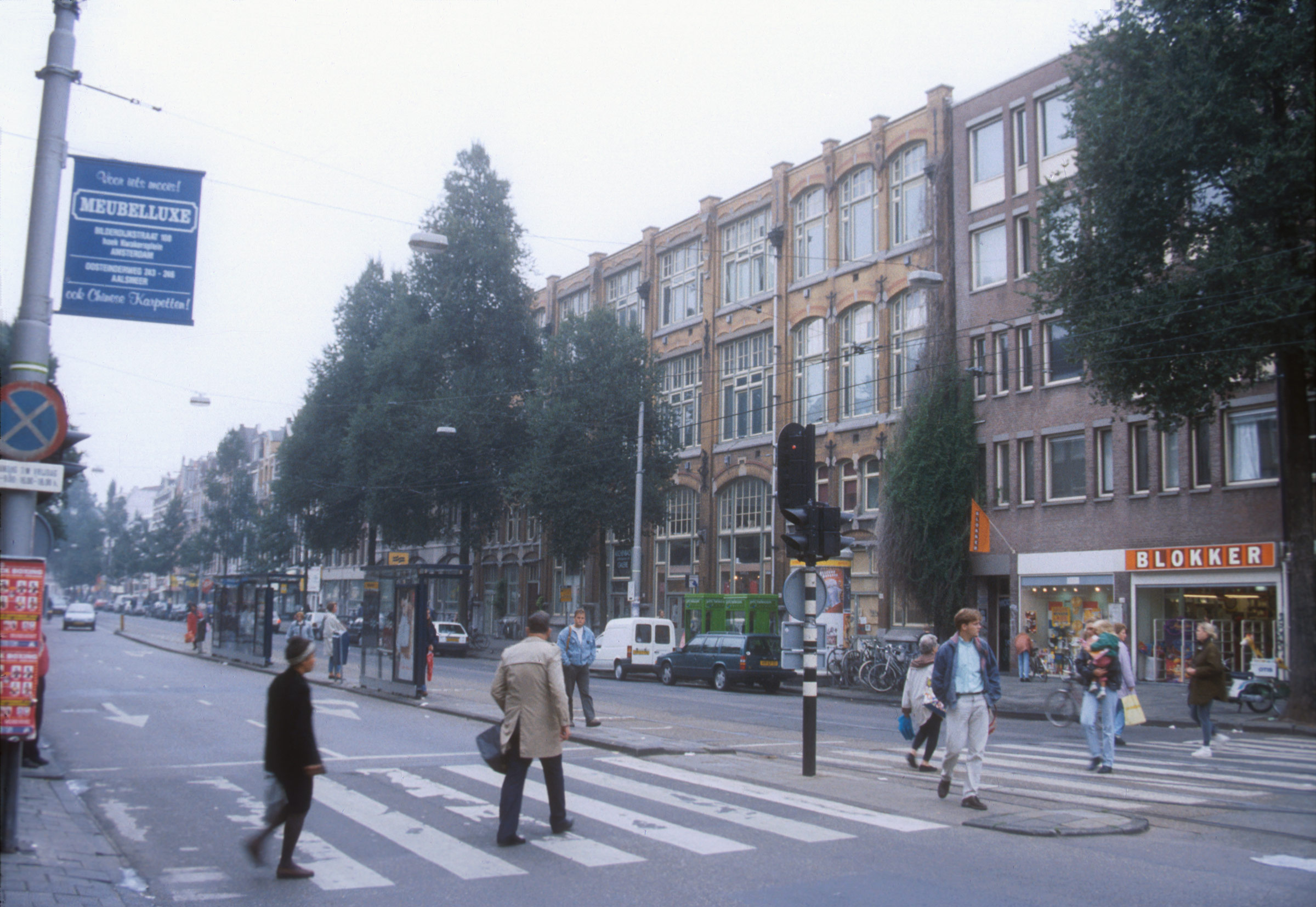
On its west side Tetterode’s street-front merges
with the busy Biderdijkstraat, a traffic infested major
shopping street, serving with the Kinkerstraat the populous suburb of the
Kinkerbuurt.
BILDERDIJKSTRAAT WEST-FACE OF
TETTERODE: OLD BUILDING
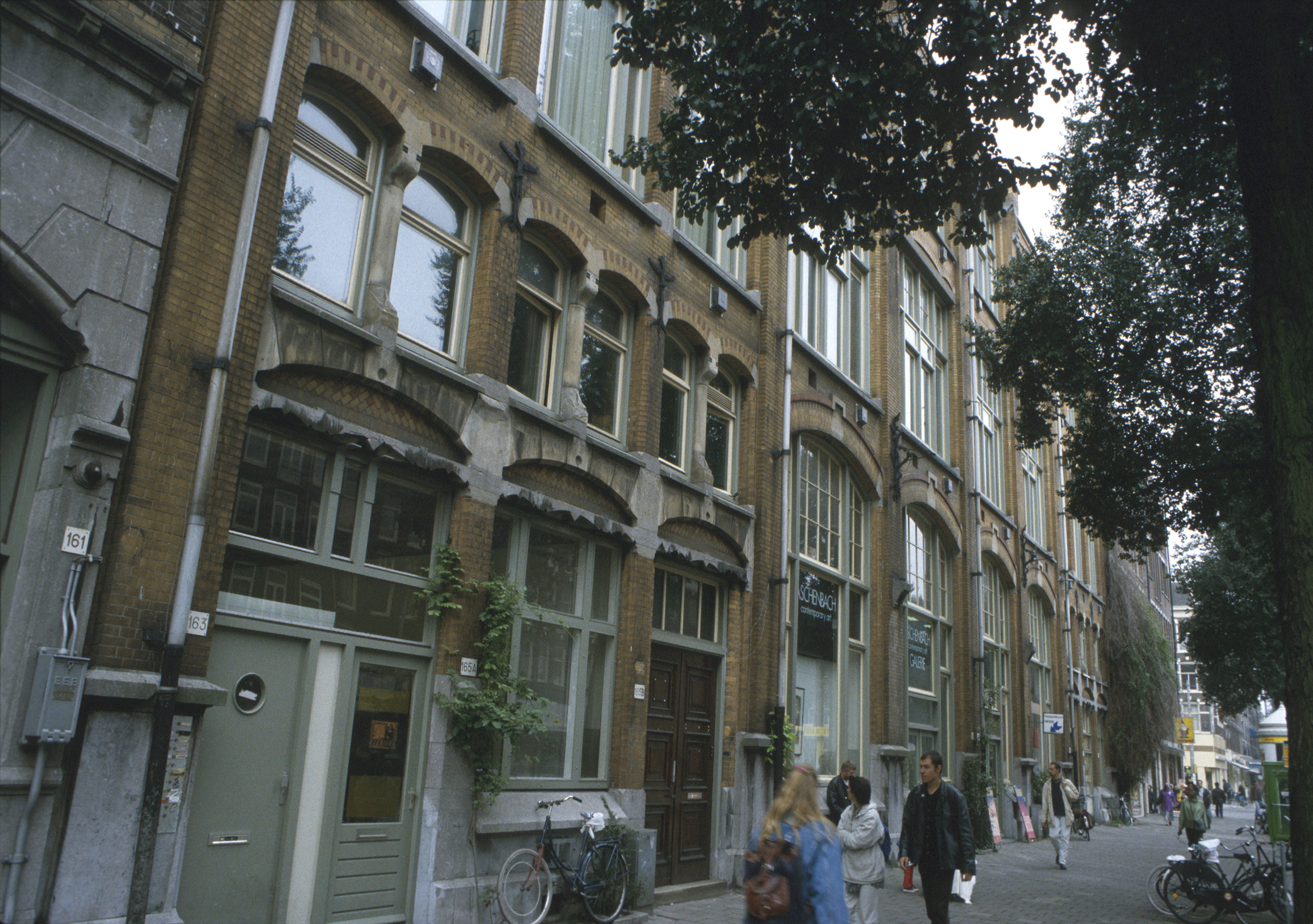
(pic 09-1994 / to SE)
Hartkamp's 1901 building initiated
the Tetterode company on this site.
People passing by need hardly know this as a squat (unless they remember the political
and neighbourhood activity of its youth). Tetterode’s own entrances interleave unnoticeably with shops
and café, and its big 1901 Jungenstijl street level windows
comfortably transit from factory to commercial art gallery and clothes
shop.
BILDERDIJKSTRAAT WEST-FACE OF
TETTERODE: ALL FROM NORTH END
(pic 17-04-2008 / to SE)
This is the whole Bilderdijkstaat facade, from the north end of the old
building's north extensions. Parts of these were squatted in the late
1980s: their street level offices: three arched bays [pic: rt] and the two
crudely renovated street-windows [pic:lt], plus the floor above the
latter.
.
TETTERODE'S INNER FACADES AND CENTRAL COURTYARD
COURTYARD:
MAIN ENTRY -
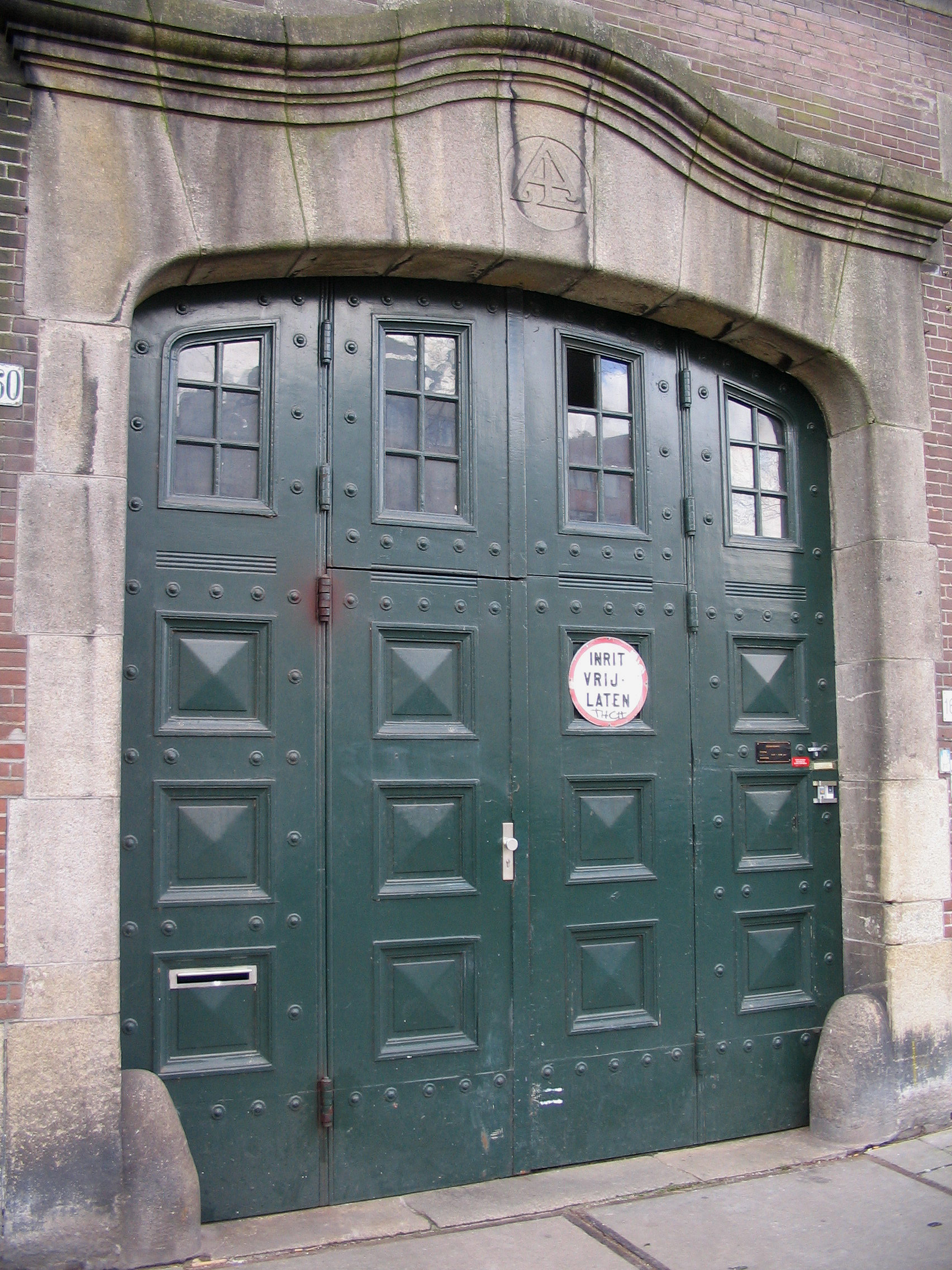
DACOSTAKADE VEHICLE ENTRY [5A] Tetterode's
vehicle entry-door at the S end of the Hartcamp building.
COURTYARD:
MAIN ENTRY -
DACOSTAKADE VEHICLE ENTRY TUNNEL The
vehicle entry-door fronts a tunnel that passes under the Hartcamp building and
opens directly into the SE corner of the Courtyard.
COURTYARD: FROM HARTCAMP'S
LEVEL 6 TERRACE
Looking down into the
central courtyard from 25 meters up on the south-west corner terrace (my ‘Sky-Lawn’)
of the Dacostakade
Hartcamp building [hc-L6].
When squatted the court was a roofed garage - on legalisation
fire-regs required an open-air escape space.
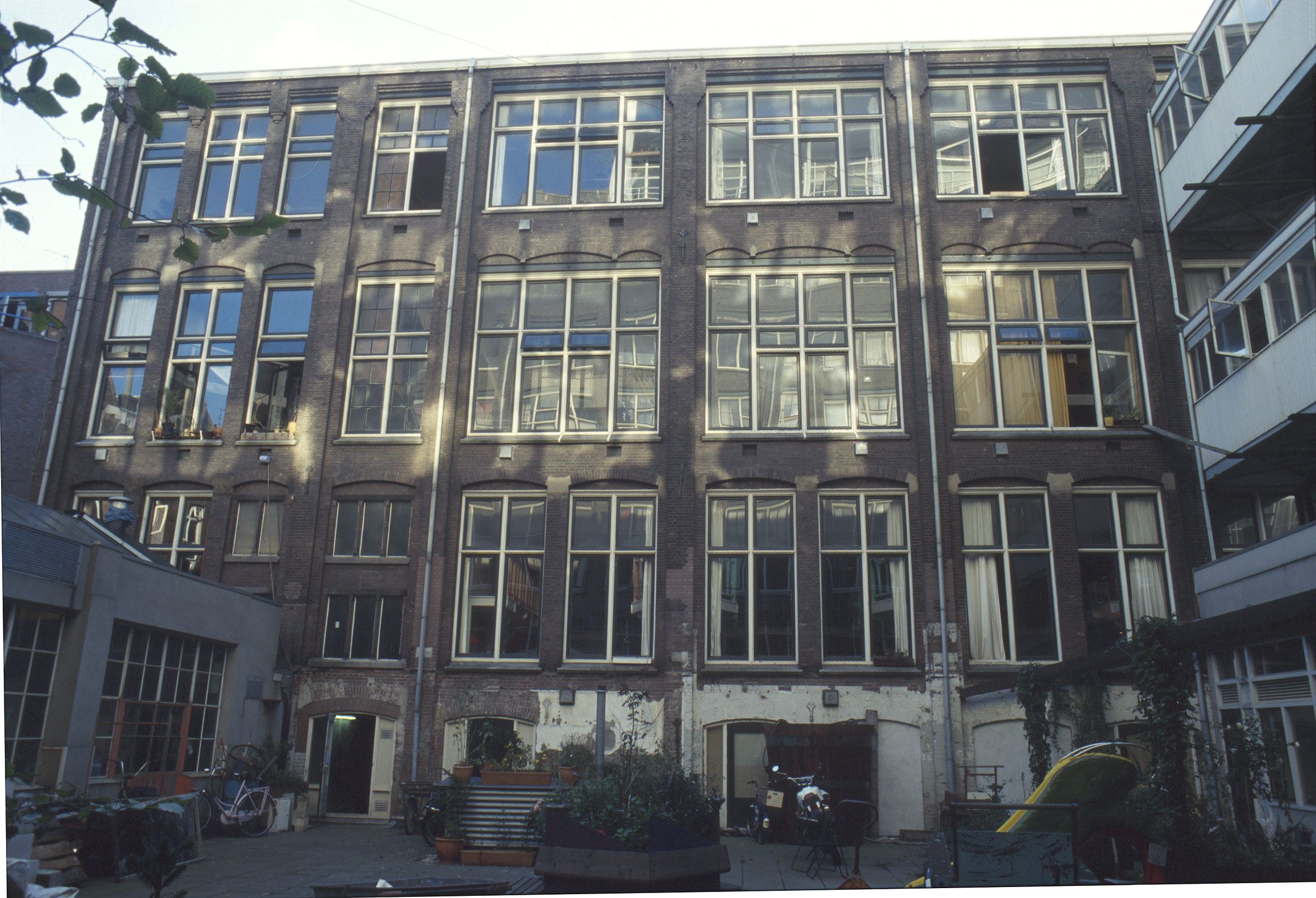
The windows of the "Lettermagazijn"
enclave [bd-L1] face across the court; on the left are metal workshops, to the right, above
more workshops, the bridge to the 'Glazed-Court' enclave [bd-L2].
Between
Rein van der Vliet’s central seat & the front-door of his
tool-hire/metal-workshop, objects and plant-troughs, in association
with the veranda roof-frame, are perhaps beginning to define an enclosure
- in such ‘free’ environments architectural features grow with use!
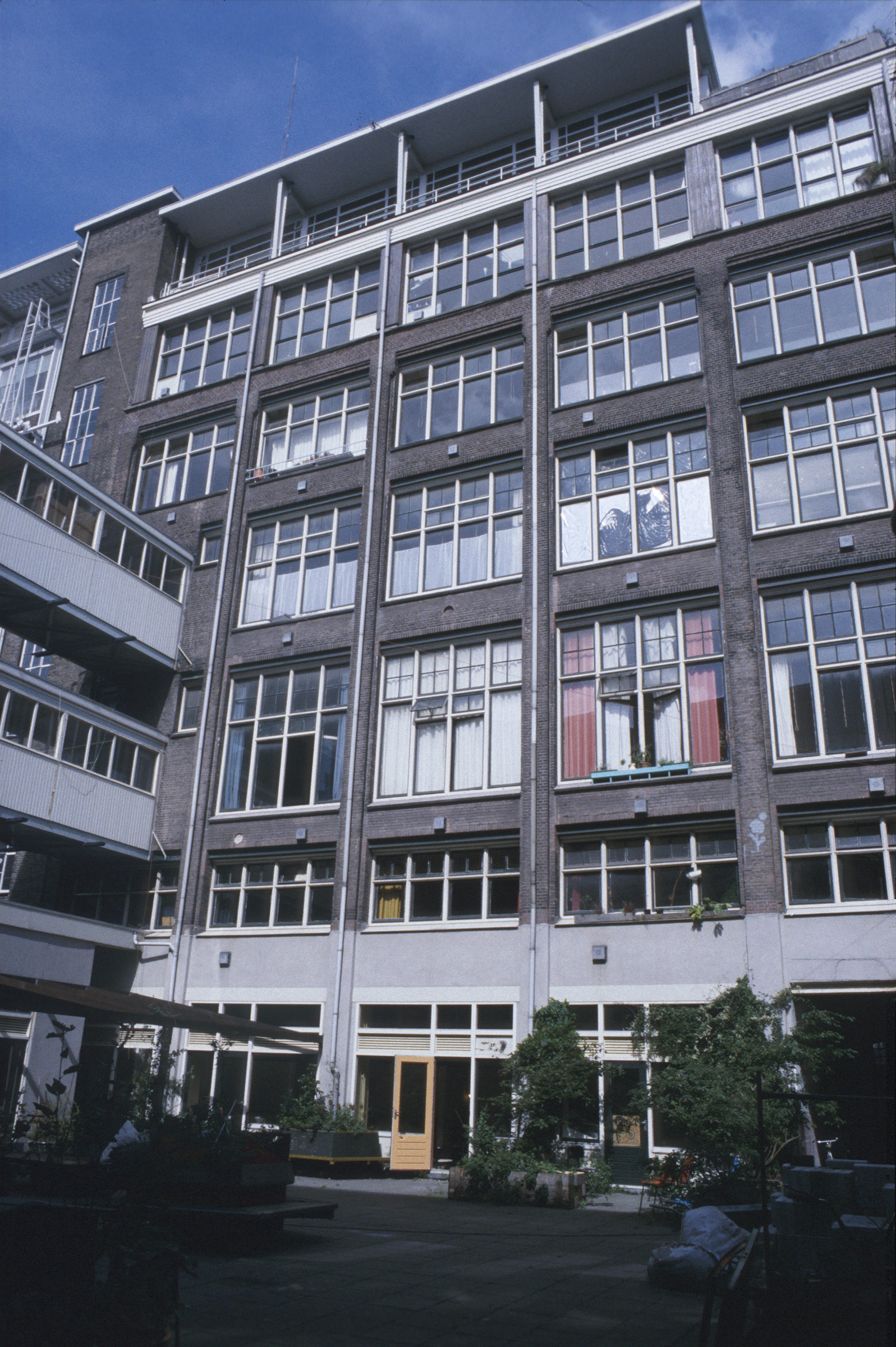
COURTYARD
W-FACADE: BILDERDIJKSTRAAT BUILDING
The
courtyard's west facade is the
old Bilderdijk building [bd] (Hartkamp 1901
and 1906). Its lowest level is rented mainly to external businesses and its
upper three are living-spaces. On this Courtyard side the lowest part of the
facade walls a semi-basement (rented to a night-club) The lowest window-row is the strangely isolated
"Lettermagazijn" bd-L1 enclave; the centre row are apts of the 'Glazed-Court'
bd-L2
enclave; the top row are apts of bd-L3 enclave.
COURTYARD E-FACADE: DACOSTAKADE BUILDINGS (HARTCAMP) The courtyard's east facade
is the south half of the Dacostakade [dc] block: the
1921 Hartkamp [hc] building). Merkelbach's 1963 penthouse caps the whole block.
At ground level [hc-L0] are the Dijktheatre offices, a shop, and the dark
vehicle-entrance [5A] tunnel from Dacostakade.
All
windows above this ground level are living-spaces - five apt-enclaves and the
single-apt 'penthouse': the L1"Entresol" (a lower 'half-floor');
L2; L3; L4; L5; L6.
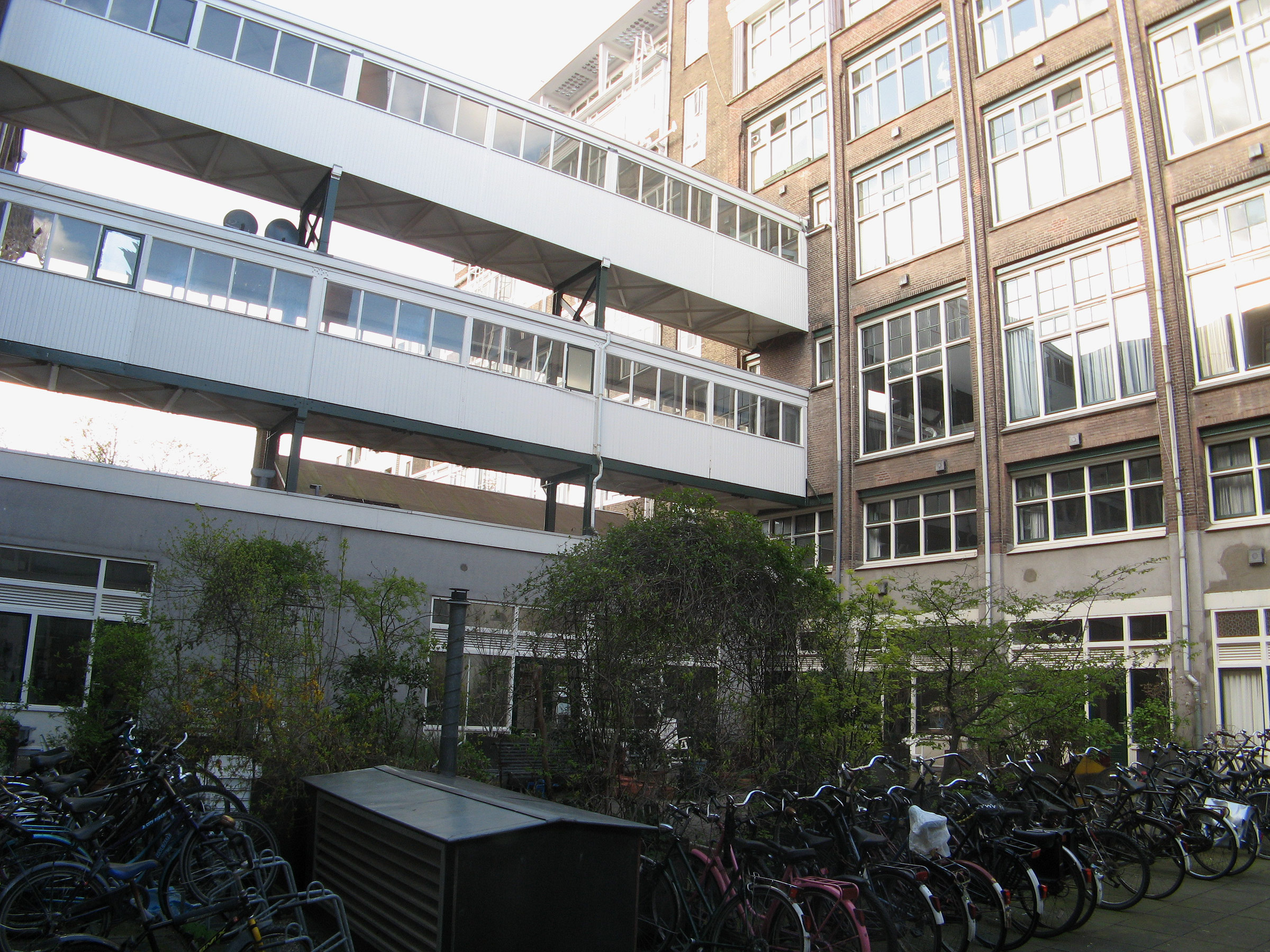
COURTYARD N+E FACADES: BRIDGES JOIN DACOSTAKADE BUILDING The
bridges
(flanked by tiny windows) enter the Dacostakade [dc] building's centre
lift/stair landings. On this courtyard side the Dacostakade block is known
as the 'Hartcamp' [hc] building, beyond the bridges - overlooking the
N-end workshops - is the 'Merkelbach' [mb] building.
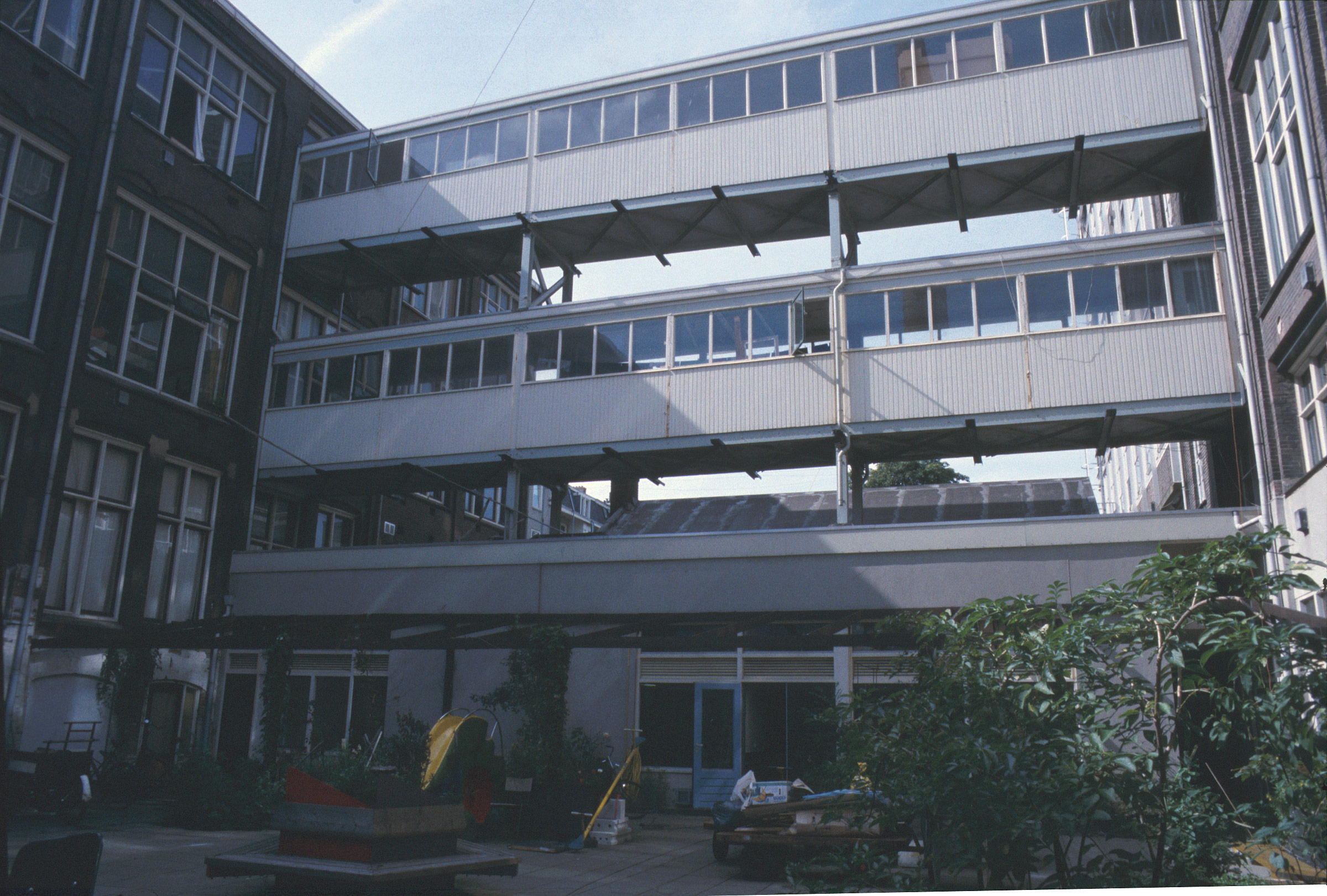
COURTYARD N-FACADE: WORKSHOPS &
BRIDGES
Workshops and bridges between Dacostakade's centre lift/stair
and the old Bilderdijk
building. The lower bridge leads from stair-landing dc-L2 directly into the bd-L2 'Glazed-Court' enclave; the upper
from stair-landing dc-L3
directly into bd-L3 enclave.
COURTYARD S-FACADE:
WORKSHOPS
Workshops
with Tetterode's chimney; backed by astonishingly sharply gabled
Kinkerstraat houses.
THE
COURTYARD FROM THE NW-CORNER UNDER VERANDA
COURTYARD E-FACADE S END WITH
SIT PLACES & THE MAIN ENTRY TUNNEL Two
work-spaces along the Courtyard's E side - on the left the Dijktheatre, on
the right the "Pret" music shop - extend their entries into
sitting places.
IN
THE COURTYARD, UNDER THE VERANDA
Objects
unconsciously ‘arranged’: the perfection of the order of convenience; a
demo of the equation of practical-usage=design.
Childrens’ play-objects, a bakfiets, an (almost) arithmetical pile of wall-building
cement-blocks - all posed on the pavement-grid like bad Surrealism or a
Renaissance space-sketch.
IN THE COURTYARD: CENTRAL CHILD PLAY AREA
In
2008 the mid-90s ad hoc scatter of childrens' play objects has become a
central playground hedged by plant-troughs.
.
THE
PRINCIPAL ENCLOSED ROUTE ACROSS THE SITE This
is the internal
route
that most nearly resembles an open alley between
one street-front and the other (between the west side Bilderdijkstraat 165B and
the east side Dacostakade
158). A general passage for commuting renters and residents alike,
locked at both street ends but with no
internal barriers, which serves almost all (the central courtyard access is
sometimes locked) work-zones: the rear of the
Bilderdijk Art Gallery, the rear of the courtyard's north side businesses, the workshops of the North-End,
the rear
of the Dacostakade street workshops, and the stairs up to the Merkelbach level-1
"Entresol" 'work-enclave' and beyond - for
residents and visitors to the upper parts of both Dacostakade buildings the
stair continues up for five more levels of locked residential enclaves.
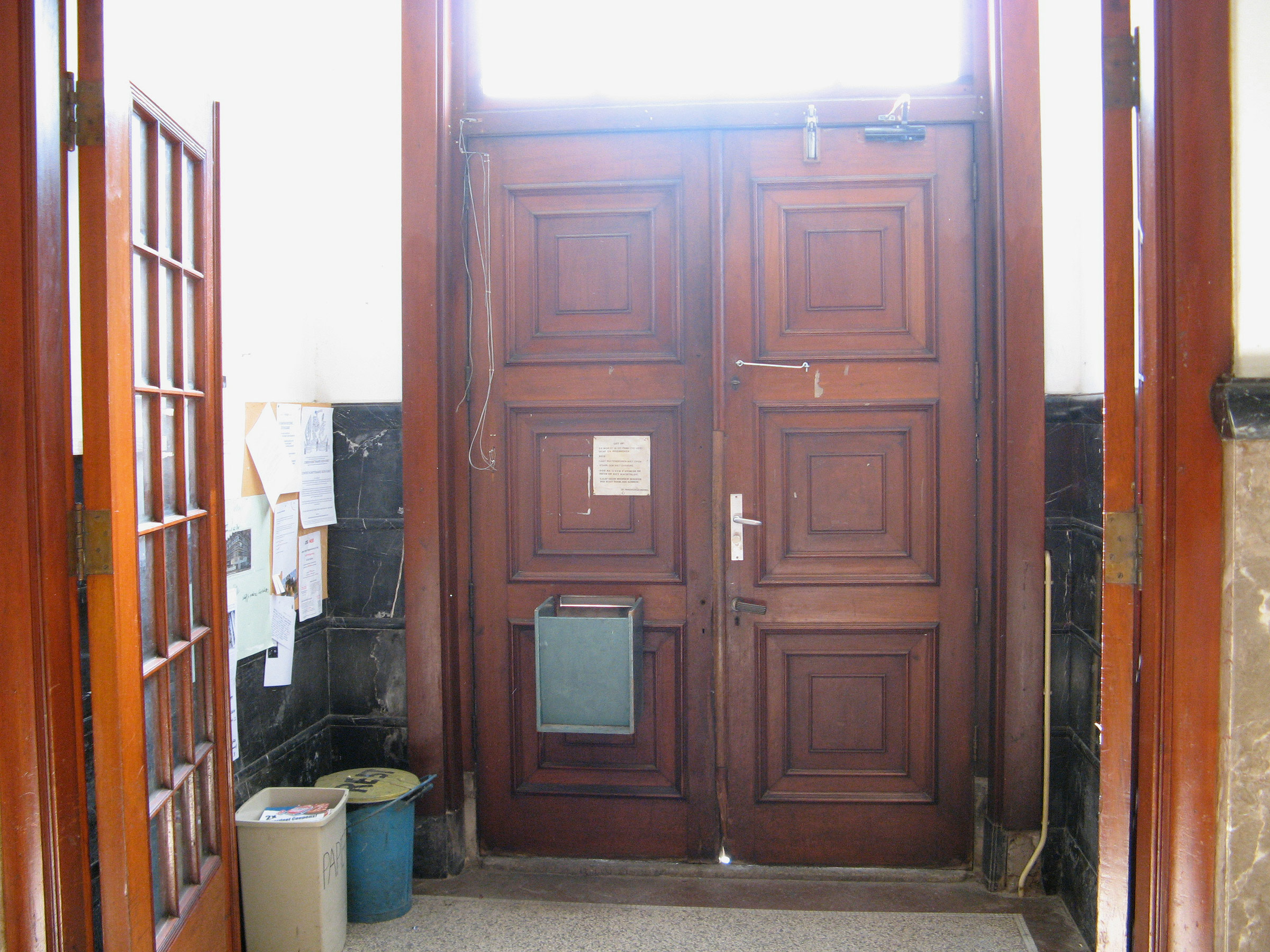
BILDERDIJKSTRAAT
COMPANY ADMIN
ENTRY 165B (pic
1-05-2008 / to WWS)
Outside this heavy door is the sudden rush of bustling Bilderdijkstraat.
BILDERDIJKSTRAAT
COMPANY ADMIN
ENTRY: HALLWAY (pic
19-04-2008 / to EEN)
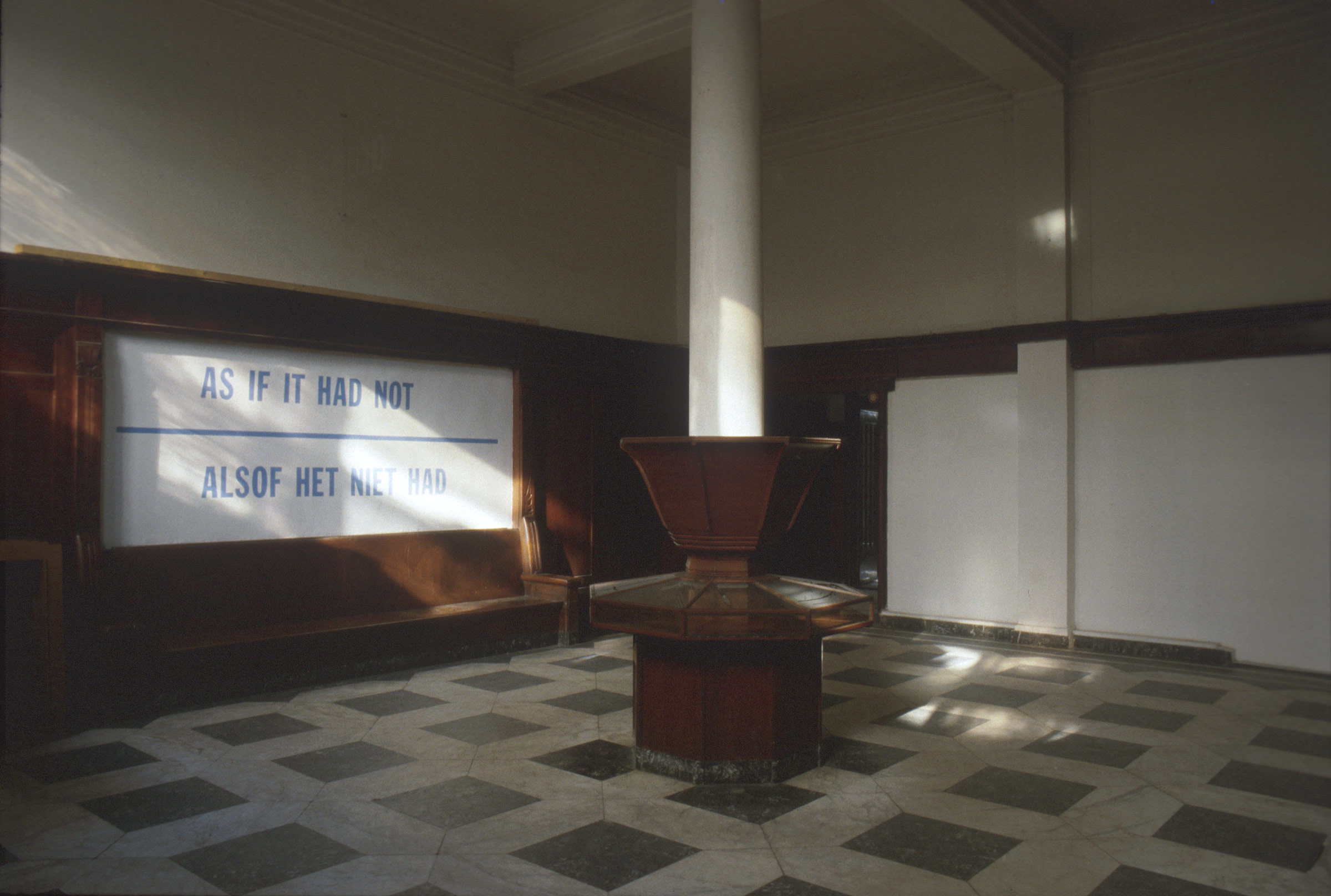
THE
COMPANY RECEPTION HALL: TO THE BILDERDIJKSTRAAT ENTRANCE (pic
08-1993 / to WWS) The
strangest and grandest of the three Bilderdijk street entries is the 1921
‘management entrance’. One
is ushered by mirrors over marble into a once lavishly panelled (now mostly
stripped) 11m x 8m reception hall, centered on a 7m-high feature: a Doric
pillar springing like a (- kitsch inevitably invites mixed similes -) giant
pistil from a petalled mahogany ‘salad-bowl’ skirted with a showcase
like a glass tutu (for displaying Company memorabilia?).
THE COMPANY RECEPTION HALL: TO THE N-END PASSAGE
(pic 08-1993 /
to SSW)
[written
c1994: direct impressions]
From this magnificence there is now nowhere suitable to go - a narrow
boarded passage exits from its rear into the tangle of workshops behind
Merkelbach. With no present
intention to power its pomposity it has become a cavity of the past - an
almost empty place, restful, dreamy, stained with nostalgia - its spacious
silence evaporates the tension of the busy street - an ante-room to the
interior world of Tetterode: huge domestic and working pueblo.
THE N-END PASSAGE FROM HALL TO
THE EAST SIDE
(pic 12-04-2006 / to EEN)
The passage from the rear of the Co. hall enables a walk through the whole site from Bilderdijkstraat to
Dacostakade - passing between the two blocks of workshops (of the North-end
and the Courtyard) and joining tributary routes that ultimately access the whole of
Tetterode.
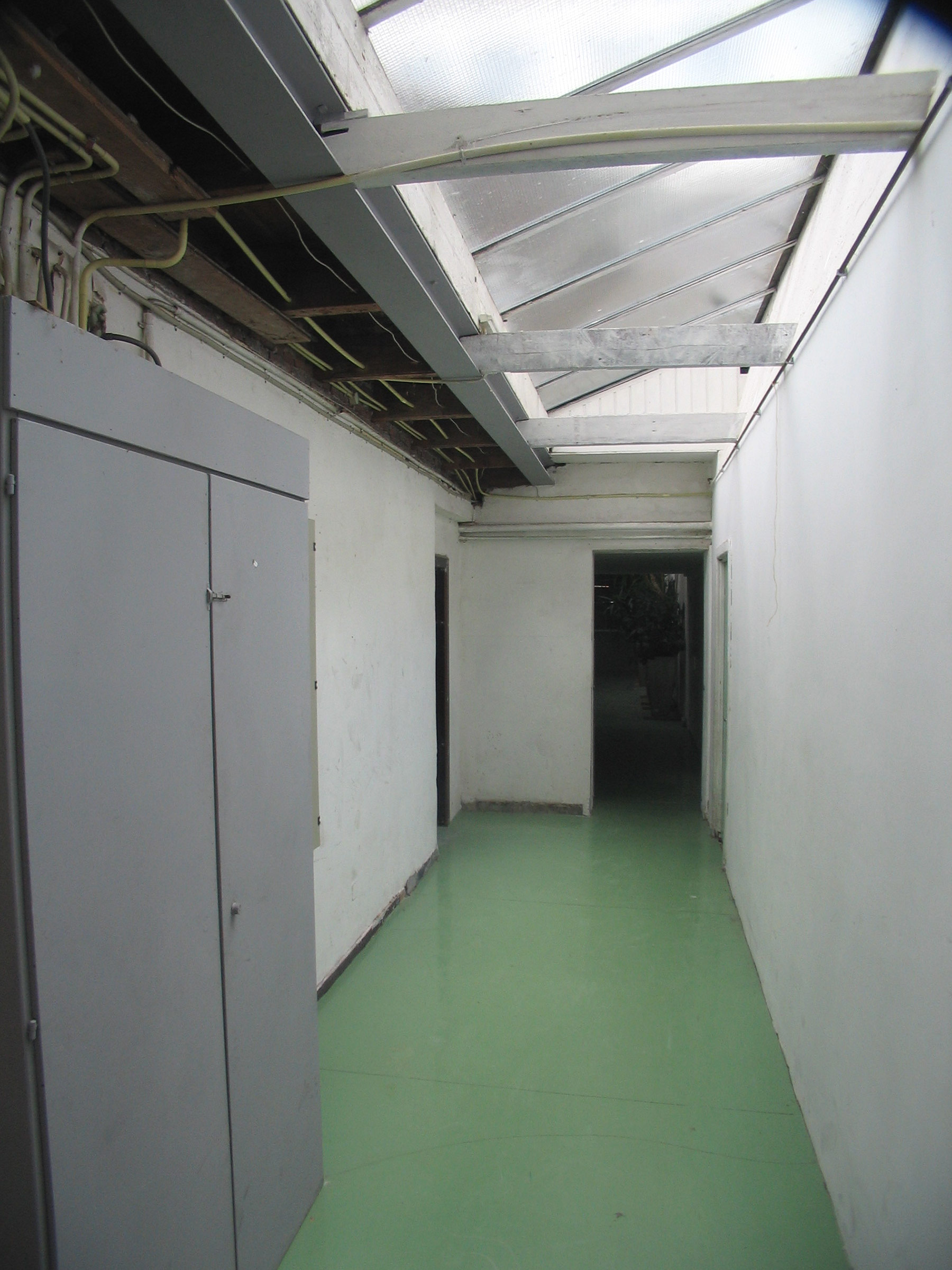
Smartened up in the late 90s, this passage no longer underscores the pathos of
the 'great' hall with sudden petty scale and shabby ad hoc walls [alas, there are no early 90s
photos].
THE N-END PASSAGE FROM HALL TO
THE EAST SIDE
(pic 08-1993 / to EEN)
Near
the passage's east end where it widens
and heightens between
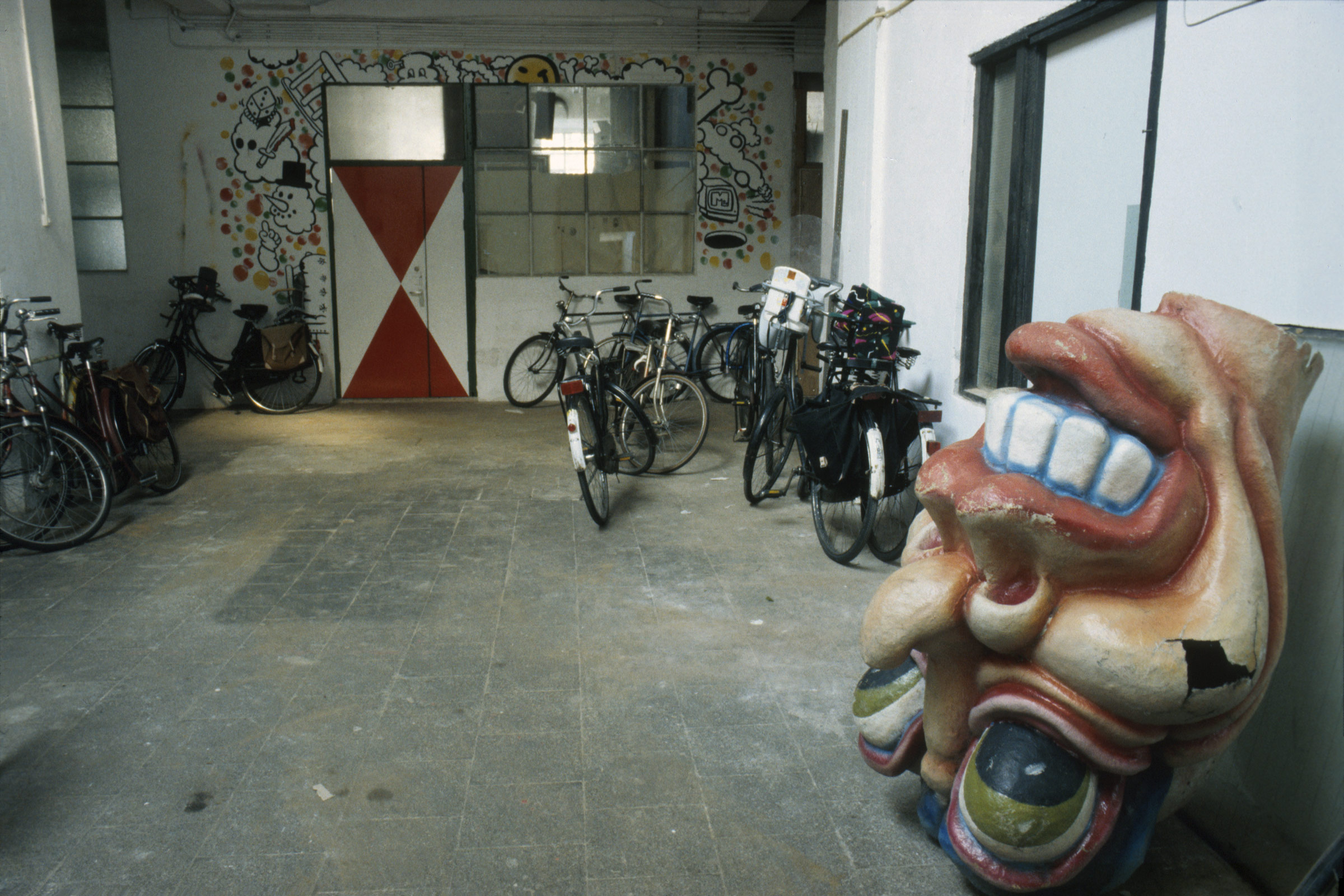
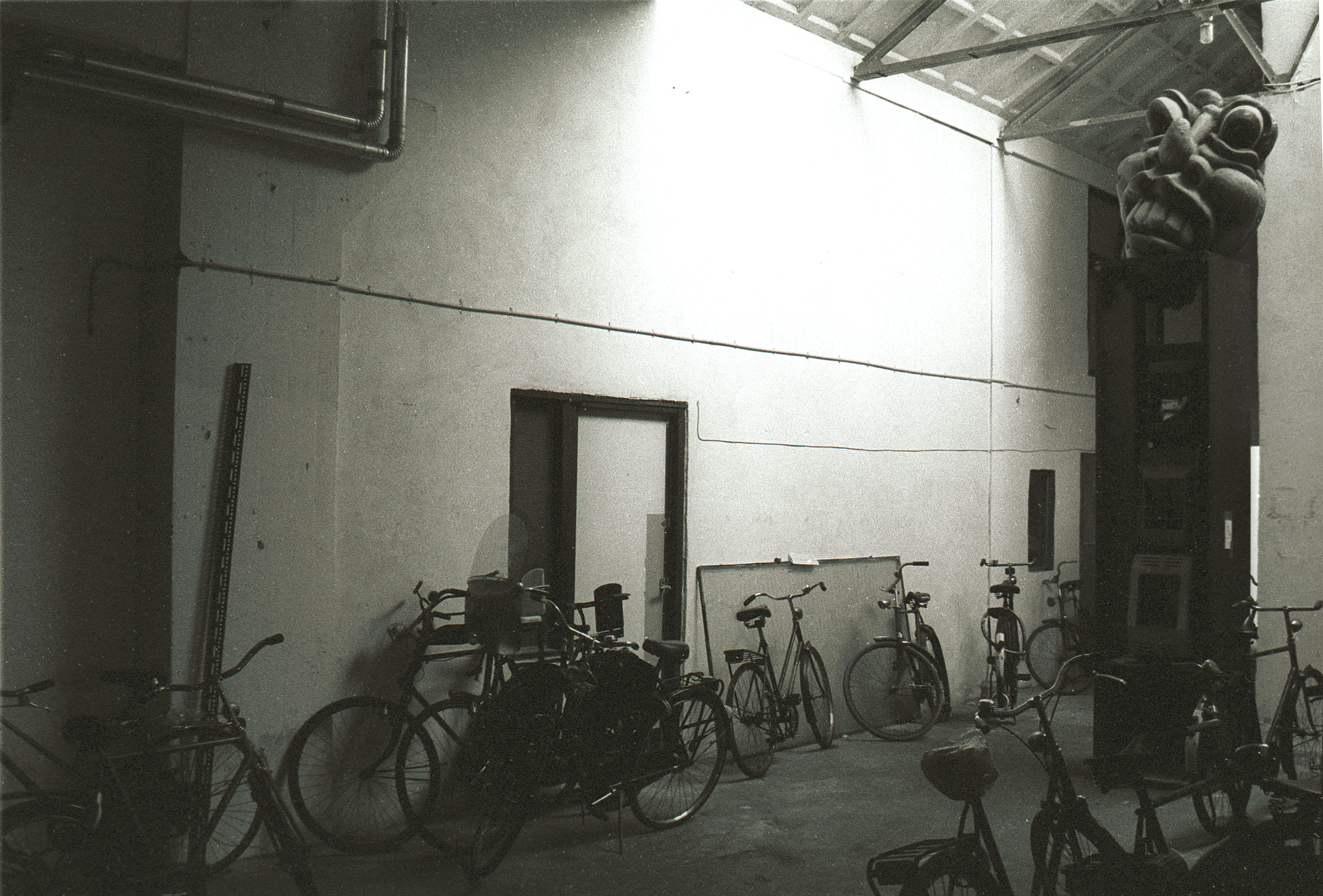
the workshops' inner walls. Facing us is the inner wall of Merkelbach's four
Dacostakade fringing workshops; to the left opens a cul-de-sac serving two of these workshops, to the right is Dacostakade's centre stair/lift and a
passage to residents' street entry 158.
THE N-END PASSAGE FROM HALL TO
THE EAST SIDE
(pic 08-1993 / to SSW)
View back from the passage's east-end. On the left are Courtyard workshops; to our right
the North-end block; behind us is Merkelbach.
THE N-END PASSAGE FROM HALL TO
THE EAST SIDE
(pic 17-04-2008 / to SW) THE N-END PASSAGE &
DACOSTAKADE BLOCK'S CENTRE LIFT/STAIR FOYER
(pic 15-04-2008 / to S)
The
east termination of the N-end passage - here it meets the foyer of the
Dacostakade block, joins routes (stair and lift) to its upper levels; an entry
to the Courtyard's NE corner, and a residents exit onto Dacostakade. Here the
'restyling' has
produced a strange juxtaposition: the newly decored 'corporate' hallway (an
inner entry point for rented business and workshop spaces) abjures the dark shabby
(more 'domestic') bike encumbered Dacostakade foyer.
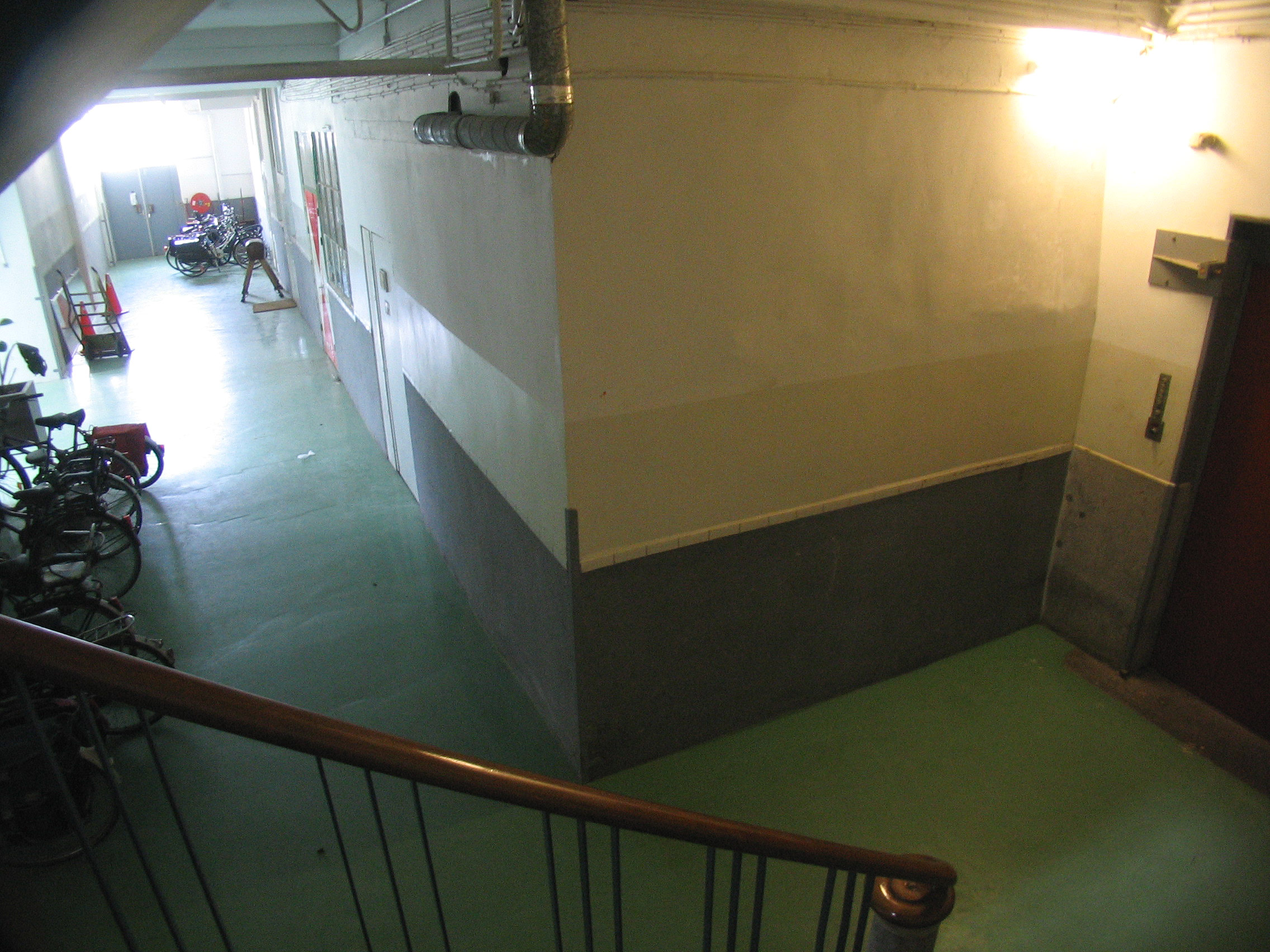
THE N-END PASSAGE: THE MERKELBACH BRANCH - VIEW FROM DACOSTAKADE BLOCK'S CENTRE STAIR A
view along the rear of the four Dacostakade workshops (a cul-de-sac for
visitors - ending in a locked door into the Kindergarten playground). Past
the bike-stands the North-End passage opens to the left (west). The stair
rises from Dacostakade's foyer to the level-1 'Entresol'
work-zone plus all Dacostakade (Merkelbach's and Hartcamp's) residential levels.
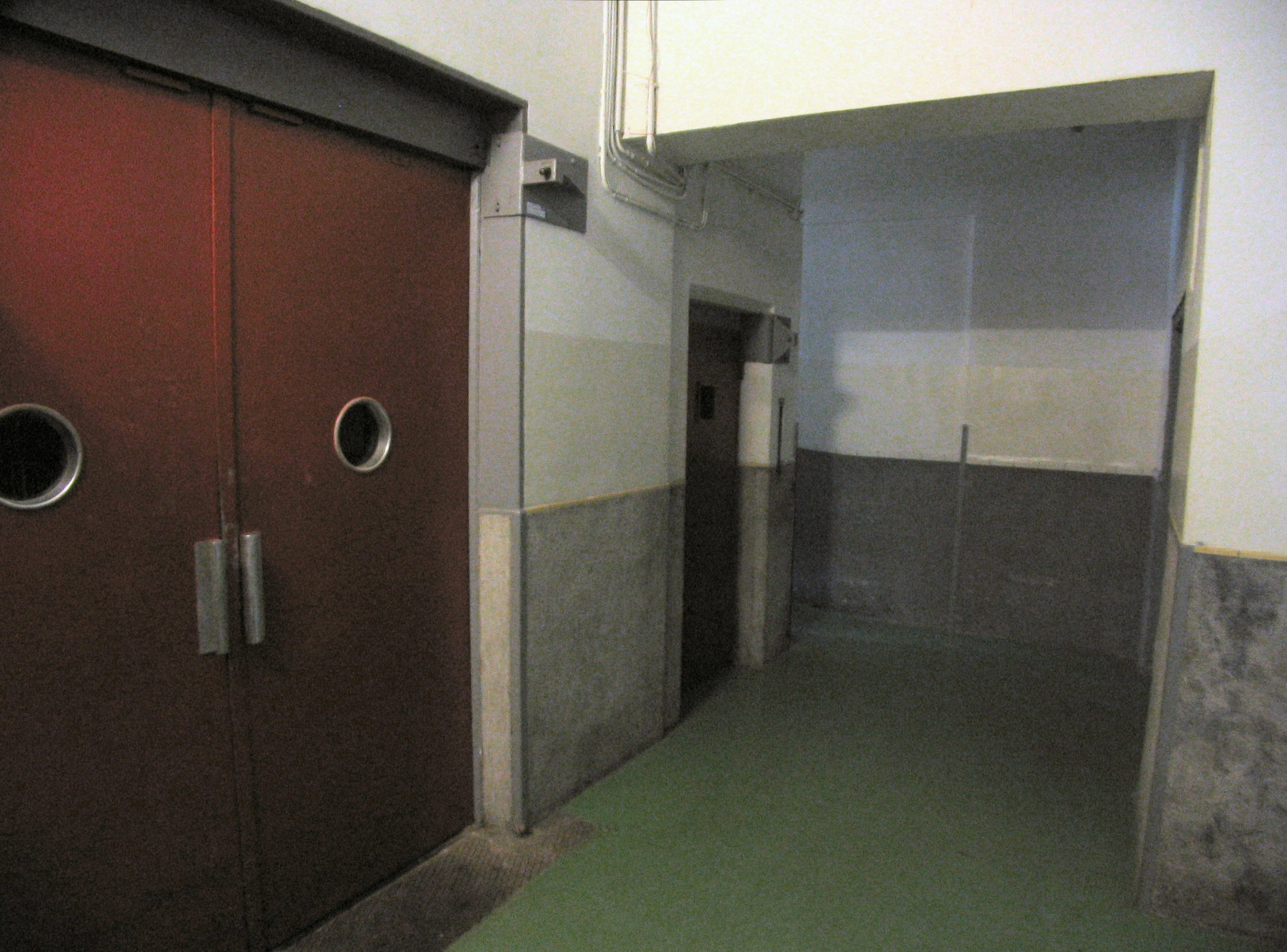
THE
N-END PASSAGE: THE DACOSTAKADE BLOCK'S CENTRE LIFT/STAIR FOYER (pic
12-04-2006 / to
SE)
Dacostakade's centre stair/lift
foyer with its main (goods) lift doors. At the far end is a defunct passenger
lift and round the far corner, the
passage to residents' street entry 158.
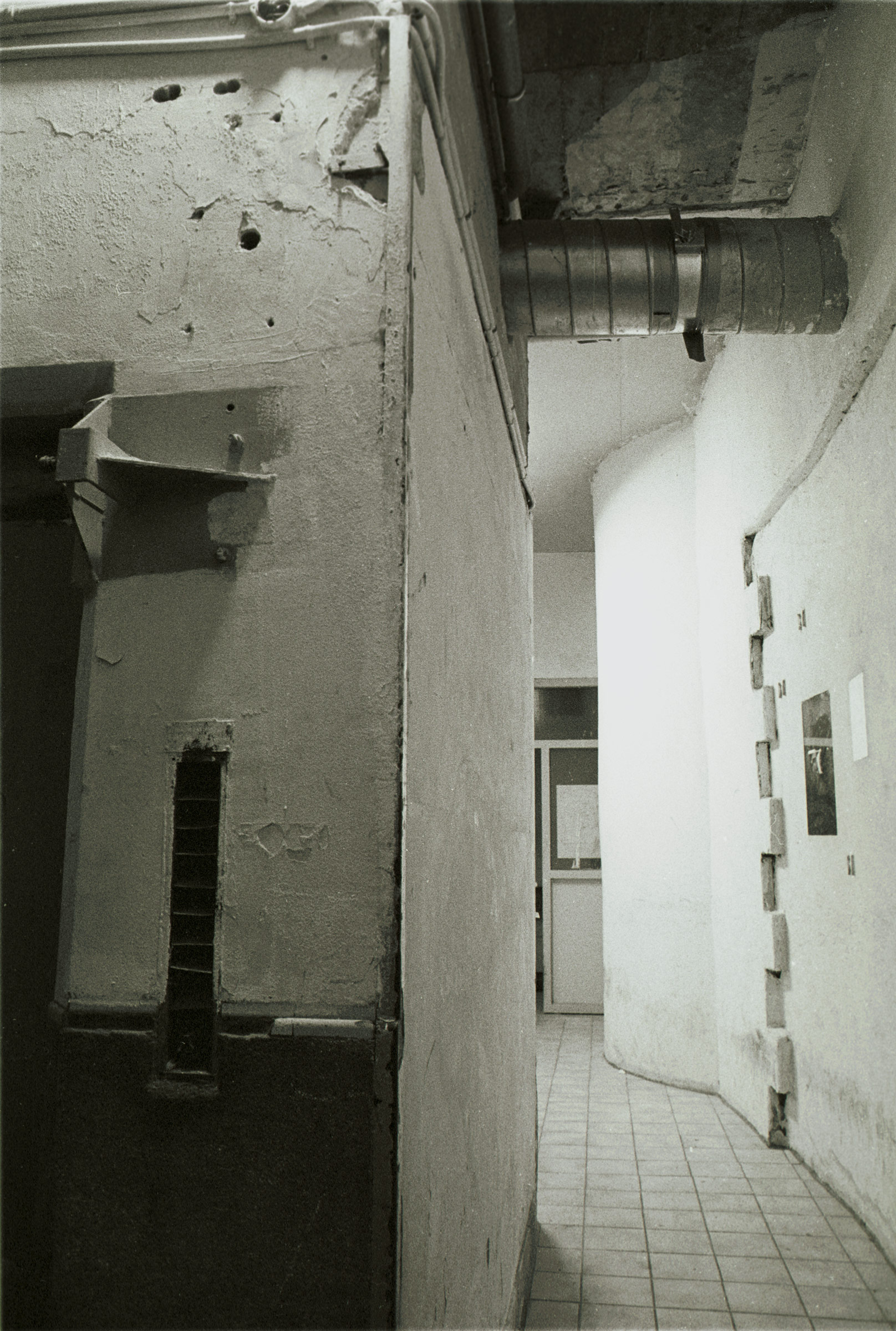
DACOSTAKADE BLOCK'S CENTRE LIFT/STAIR FOYER: THE PASSAGE TO DACOSTAKADE
158 ENTRY The
passage to the residents' Dacostakade street entry 158. On
the right (S side) is the wall of the Dijk Theatre; this was miscalculated
and had to be rebuilt to allow the passage of trolleys.
.
TETTERODE - p1: INTRODUCTION
>
TETTERODE - p4: DACOSTAKADE BUILDINGS: MERKELBACH & HARTCAMP > >
TETTERODE - p5: DACOSTAKADE: MERKELBACH APTS - mb//mb1/mb2 > >
TETTERODE - p6: DACOSTAKADE: MERKELBACH APTS - mb3 > >
TETTERODE - p7: DACOSTAKADE: MERKELBACH APTS - mb4 > >
TETTERODE - p8: DACOSTAKADE: MERKELBACH APTS - mb5/mb6 > >
TETTERODE - p9: DACOSTAKADE: HARTCAMP APTS - hc//hc1/hc2 > >
TETTERODE - p10: DACOSTAKADE: HARTCAMP APTS - hc3 > >
TETTERODE - p11: DACOSTAKADE: HARTCAMP APTS - hc4(1) > >
TETTERODE - p12: DACOSTAKADE: HARTCAMP APTS - hc4(2) > >
TETTERODE - p13: DACOSTAKADE: HARTCAMP APTS - hc5/hc6 > >
TETTERODE - p14: BILDERDIJKSTRAAT BUILDINGS > >
TETTERODE - p15: BILDERDIJKSTRAAT APTS - bd//bd1 > >
TETTERODE - p16: BILDERDIJKSTRAAT APTS - bd2 > >
TETTERODE - p17: BILDERDIJKSTRAAT APTS - bd3 > >
TETTERODE - p18: BILDERDIJKSTRAAT APTS - bdN >
[Written 1990s]

.

[all
plans single sheet]
[all
plans single sheet]
[all
plans single sheet]
[all
plans single sheet]
[all
plans single sheet]
[all
plans single sheet]
[all
plans single sheet]
[all
plans single sheet]
[all plans single sheet]
[Written 1990s]
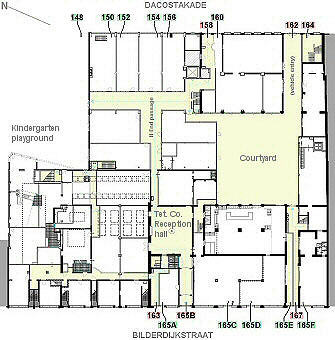
(Mikel van Gelderen 2006
/ amended 2008 / top is EEN)
There
are 2
types of entry into this city-block-spanning site:
.jpg)

(pic 12-04-2006 / to W)
(pic 08-1990 / to W)
(pic 08-1993 / to WWS)
(pic 08-1993 /
to WWS)
(pic 08-1993 / to
NE)
(pic 16-04-2008 / to NNE)


(pic 08-1993 / to NW)
(pic 08-1993 / to SE)
(pic [damaged] 08-1993 / to EES)

(pic 1993 / to EEN)
(pic 08-1993 / to WWS)
(pic 22-04-2008 / to EES)

.jpg)
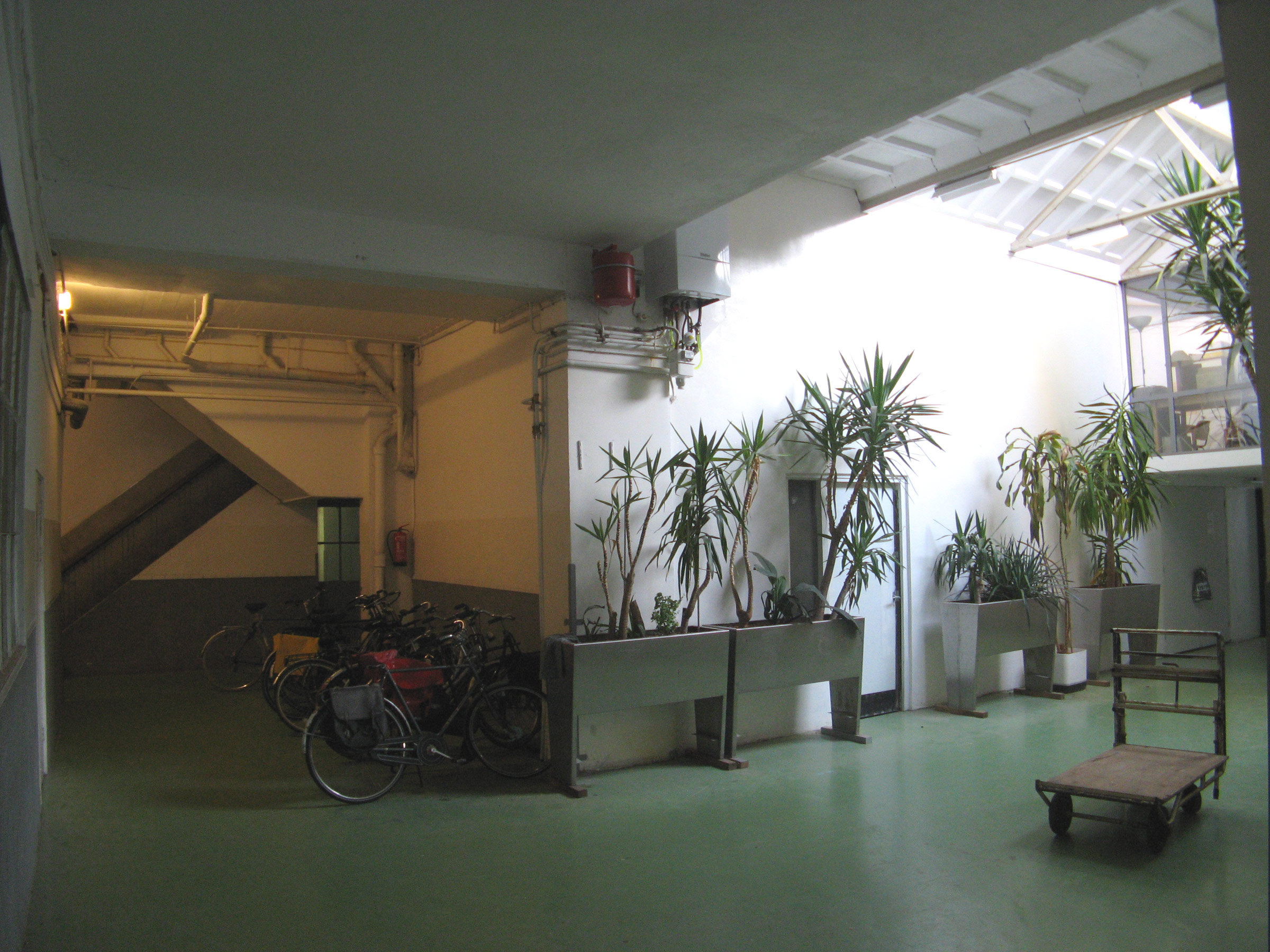
The
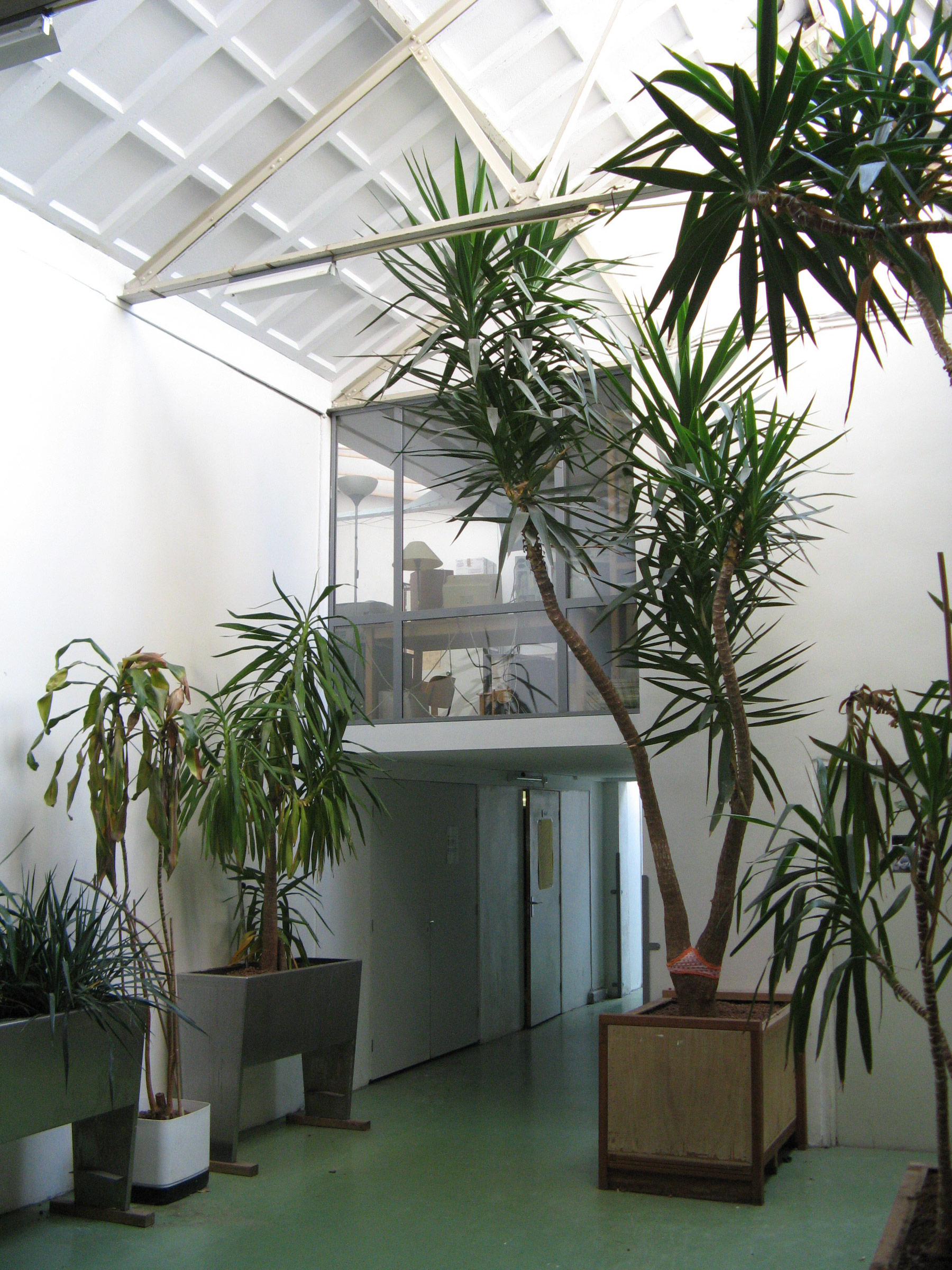
late 90s smartening of the austere N-end passage [see previous pic] has
transformed (presumably for
outside users of its rented work spaces)
the gloomy bike-cluttered space into a 'sketch' of a
corporate 'palm-court' entry-hall. Its ludicrous 'smartiness' has been lampooned
by a Tett resident who rendered the bifurcated yucca 'decent' with sewn on knickers.
(pic 12-04-2006 /
to N)
(pic 08-1993 / to EES)
> TETTERODE - p2: PUBLIC-USE &
WORK-SPACES >
>
TETTERODE - p3: RESIDENTIAL DOMAINS >
CONTENTS
4 SITES
TETTERODE
DE LOODS
EDELWEIS
APPENDICES
NOTES
SUB-SITES